IDR plans deep dive — SAVE, IBR, PAYE, ICR and discretionary income
The four federal student loan income-driven repayment plans: discretionary income, payment caps, recertification, marriage penalty, PSLF interaction.
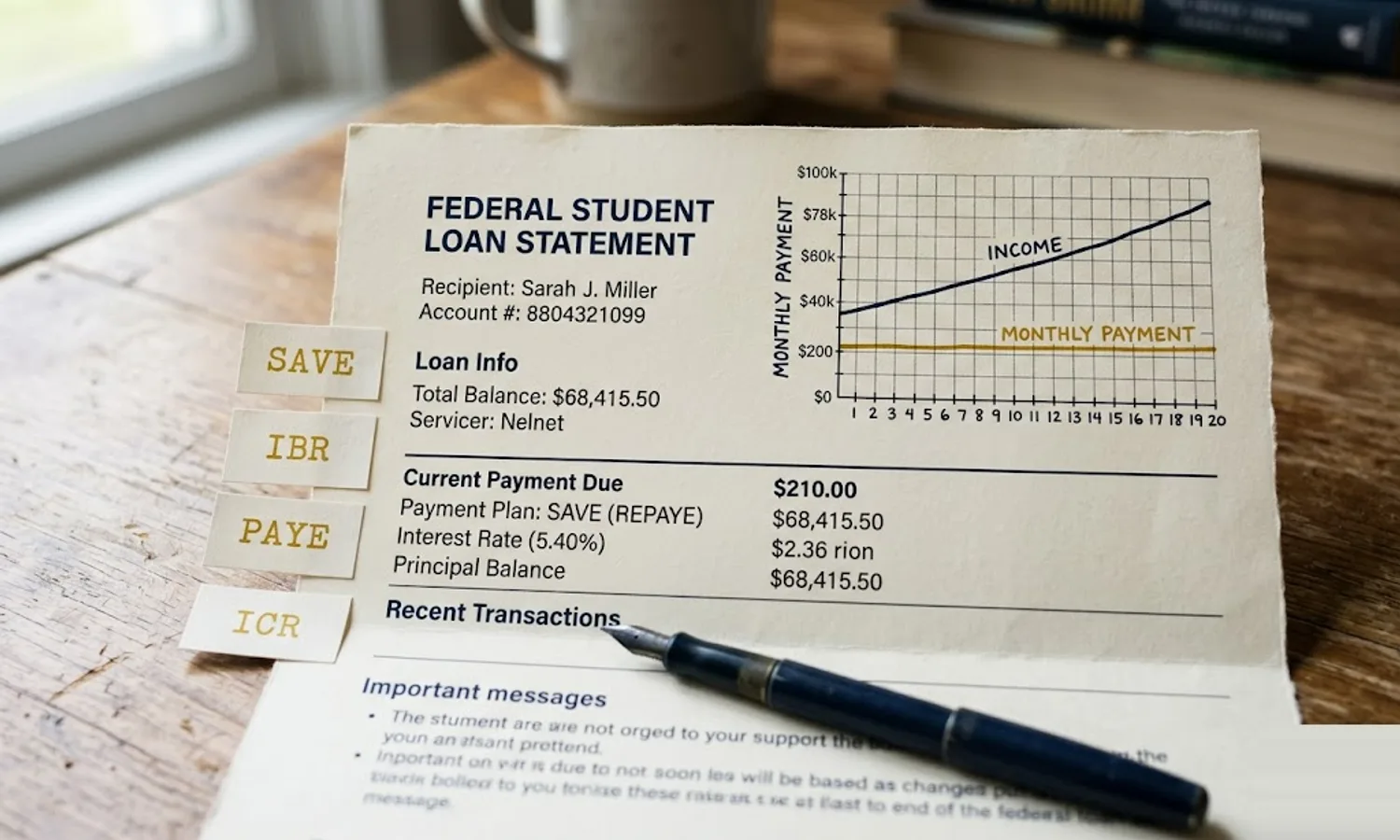
US federal student loans come with a set of payment-capping options that have no parallel in private lending: the income-driven repayment (IDR) plans, which cap monthly payments at a percentage of the borrower’s discretionary income, recompute the payment annually as income changes, and forgive any remaining balance after 20-25 years of payments. The IDR system is the structural reason that federal student loans are dramatically more flexible than private student loans for borrowers whose income may fluctuate — and the reason that refinancing federal loans into private loans forfeits substantial option value, sometimes called the “IDR insurance” value of keeping loans federal.
This guide walks through the four IDR plans (SAVE, IBR, PAYE, ICR), how each computes the monthly payment, the differences in discretionary income definition and payment percentage, the marriage filing penalty that catches many borrowers off-guard, the annual recertification mechanics that determine each year’s payment, the interaction with Public Service Loan Forgiveness (PSLF), and the household profiles for which each plan is structurally optimal. The SAVE plan was ultimately struck down in court, and a new option — the Repayment Assistance Plan (RAP) — replaces it for income-driven repayment starting July 1, 2026; this guide flags where that change matters.
Every threshold, percentage, and rule cited is sourced to studentaid.gov, 34 CFR (the federal regulations on student loans), and the Federal Student Aid Handbook. Specific implementation details change with each administration and with each appropriations cycle.
Why IDR exists and what it provides
Federal student loans were originally designed to amortize on a standard 10-year schedule — equal monthly payments over 120 months. The standard plan works well for borrowers whose post-graduation income matches the loan balance reasonably. It works poorly when the loan balance is high relative to income (graduate and professional school borrowers) or when income is variable or rising slowly (early-career borrowers).
The federal response over four decades has been to add a series of “alternative repayment plans” that cap the monthly payment based on income rather than amortization schedule. The current IDR family — SAVE (Saving on a Valuable Education), IBR (Income-Based Repayment), PAYE (Pay As You Earn), and ICR (Income-Contingent Repayment) — represents four iterations of the same idea: replace the amortization-based payment with an income-based payment, and forgive any remaining balance after a defined number of years (20-25, depending on plan and loan type).
The IDR structure provides three benefits for borrowers:
Cap on monthly payment. Borrowers cannot be required to pay more than the IDR formula produces, even if the standard amortization payment would be higher. A borrower with $200,000 of loans at 6% on a 10-year standard plan owes $2,220/month; the same borrower on SAVE with $40,000 AGI owes roughly $25/month. The IDR cap is the difference between a manageable monthly burden and an unsustainable one.
Forgiveness at the end of the repayment period. Any balance remaining after 20 years (PAYE, SAVE undergraduate) or 25 years (IBR, SAVE graduate, ICR) is forgiven. The forgiven amount is treated as taxable income in the year of forgiveness for most IDR programs — though Public Service Loan Forgiveness forgiveness is specifically tax-free, and the American Rescue Plan Act made IDR forgiveness tax-free through 2025 (with the post-2025 treatment depending on subsequent legislation).
Insurance against income shock. A borrower whose income drops (job loss, career change, return to school, family caregiving) can recertify and have their IDR payment drop accordingly, sometimes to $0. The federal IDR system is the closest thing to “income insurance” the US offers, and it disappears the moment a borrower refinances into a private loan.
The four IDR plans — how they differ
The four IDR plans share the same general structure (monthly payment = percentage × discretionary income / 12) but differ in three key parameters: the percentage of discretionary income used as the payment, the multiple of the federal poverty guideline subtracted to compute discretionary income, and the eligible loan types. Before committing to a plan it is worth estimating the monthly payment each plan would produce for your own AGI and family size, because the spread across plans is large.
| Plan | Payment % | Discretionary income | Forgiveness | Loan eligibility |
|---|---|---|---|---|
| SAVE (formerly REPAYE) | 5% undergrad / 10% grad | AGI − 225% FPL | 10-25 years | Direct Loans (Stafford, PLUS via consolidation) |
| IBR (new borrower post-2014) | 10% | AGI − 150% FPL | 20 years | Direct + FFEL (Federal Family Education Loan) |
| IBR (older) | 15% | AGI − 150% FPL | 25 years | Direct + FFEL |
| PAYE | 10% | AGI − 150% FPL | 20 years | Direct only, new borrower post-2007 |
| ICR | 20% OR 12-yr fixed × adjuster | AGI − 100% FPL | 25 years | Direct + parent PLUS via consolidation |
The 2026 federal poverty guideline (FPL) for the 48 contiguous states and DC, published in the Federal Register January 15, 2026:
- Family of 1: $15,960
- Family of 2: $21,640
- Family of 3: $27,320
- Family of 4: $33,000
- Each additional family member: +$5,680
Alaska and Hawaii use higher FPL multipliers.
The SAVE plan’s 225% FPL multiplier is the most generous (smallest discretionary income, smallest monthly payment), which is why SAVE was the default optimal choice for most borrowers when it was fully implemented. PAYE and IBR both use 150% FPL, which is the older standard. ICR uses 100% FPL, the least generous.
The SAVE plan also uniquely included a “no interest accumulation” feature — if the monthly payment did not cover the full monthly interest accrual, the unpaid portion was waived rather than capitalized. This was the most generous feature of SAVE relative to the other IDR plans, and is one of the reasons the plan was challenged in court. The injunctions through 2024-2025 have suspended or modified parts of the SAVE implementation; borrowers should verify current SAVE status at studentaid.gov before relying on the plan for planning purposes.
Worked example — same borrower across all four plans
Consider a single borrower with $50,000 AGI, family size of 1, $80,000 of undergraduate Direct Loans, no graduate loans:
SAVE (historical — struck down in court; shown for comparison only):
- Discretionary income: $50,000 − (225% × $15,960) = $50,000 − $35,910 = $14,090
- Monthly payment: 5% × $14,090 / 12 = $59/month
IBR (new borrower):
- Discretionary income: $50,000 − (150% × $15,960) = $50,000 − $23,940 = $26,060
- Monthly payment: 10% × $26,060 / 12 = $217/month
PAYE:
- Discretionary income: same as IBR = $26,060
- Monthly payment: 10% × $26,060 / 12 = $217/month
ICR:
- Discretionary income: $50,000 − (100% × $15,960) = $50,000 − $15,960 = $34,040
- Monthly payment (20% method): 20% × $34,040 / 12 = $567/month
The plan choice produced roughly a 9-10× difference in monthly payment for the same borrower. SAVE at $59/month was the structurally optimal choice for this borrower while it existed; ICR at $567/month is the worst of the plans still standing. Since SAVE was struck down, IBR and PAYE at $217/month are now the lowest-payment options generally available for this borrower’s profile, alongside the new Repayment Assistance Plan (RAP) discussed above. The difference compounds over 20-25 years to forgiveness — the lower-payment plans accumulate a much larger forgiveable balance at the end of the repayment period.
For PSLF-tracked borrowers, a lower monthly payment on any qualifying IDR plan means a larger forgiveable balance at year 10 — which is exactly the desired outcome of the PSLF strategy. For non-PSLF borrowers, a lower monthly payment means lower out-of-pocket cost over the 20-year repayment, with the forgiveable balance taxed as income at year 20 (potentially) but still net-positive economically for most borrowers.
How discretionary income and AGI interact
The IDR formulas all use the borrower’s adjusted gross income (AGI) from Form 1040 line 11 as the income figure. AGI is derived from total gross income minus a specific set of above-the-line adjustments — see the AGI on Form 1040 line by line guide for the full computation.
The practical implication: any above-the-line adjustment that reduces AGI also reduces IDR monthly payment. The major levers:
Traditional 401(k) and traditional IRA contributions reduce AGI (these are pre-tax). A borrower contributing $20,000 to a traditional 401(k) reduces AGI by $20,000, which reduces discretionary income by $20,000, which reduces IDR monthly payment by 5% × $20,000 / 12 = $83/month under SAVE (or 10% × $20,000 / 12 = $167/month under IBR/PAYE).
HSA contributions also reduce AGI (for HSA contributions made via payroll under Section 125; outside-payroll HSA contributions are deductible on Schedule 1 line 13 which also reduces AGI). Same compounding logic: a $4,400 HSA contribution (the 2026 self-only limit, per IRS Notice 2025-67) reduces a SAVE-style 5% payment by roughly $18/month and an IBR/PAYE 10% payment by $37/month.
Self-employed retirement contributions (solo 401(k), SEP IRA, SIMPLE IRA) reduce AGI for self-employed filers and reduce IDR payment by the same compounding logic.
Half of SE tax deduction for self-employed filers reduces AGI by approximately half of the SECA tax computed on Schedule SE.
The IDR-payment-reduction effect of these adjustments is on top of the income-tax-reduction effect of the same adjustments. A borrower in the 22% federal income tax bracket contributing $20,000 to a traditional 401(k) saves $4,400 of income tax AND $1,000-$2,000/year of IDR payment, for a total annual benefit of $5,400-$6,400 on the $20,000 contribution. The IDR-payment-reduction is the under-recognized side of the math.
Roth contributions do NOT reduce AGI and therefore do NOT reduce IDR payment. For borrowers on IDR, the choice between traditional and Roth retirement contributions has an additional IDR-payment dimension that the traditional-vs-Roth decision normally ignores — see the Roth IRA vs Traditional IRA guide for the standard framework, then layer on the IDR consideration if the borrower is on an IDR plan.
The marriage filing penalty — the most consequential IDR planning issue
For most IDR plans, the borrower’s monthly payment is computed based on household AGI when filing married filing jointly. A borrower who marries a higher-earning spouse can see their IDR monthly payment increase substantially even though their own income did not change.
A worked example, using the historical SAVE formula for illustration: a borrower with $50,000 AGI (single) on SAVE paid $59/month per the calculation above. The borrower marries a spouse earning $80,000 AGI. Combined AGI: $130,000. Family size 2. Discretionary income: $130,000 − (225% × $21,640) = $130,000 − $48,690 = $81,310. Monthly payment: 5% × $81,310 / 12 = $339/month. The borrower’s payment would have increased from $59 to $339 with no change in their personal income — purely because of the marriage. Since SAVE no longer exists, the comparable calculation on IBR (the plan most borrowers use now) is starker: discretionary income $130,000 − (150% × $21,640) = $130,000 − $32,460 = $97,540, monthly payment 10% × $97,540 / 12 = $813/month — versus $217/month for the same borrower filing single.
The mitigation is filing Married Filing Separately, which uses only the borrower’s individual income for IDR computation under PAYE and IBR (SAVE also honored MFS while it existed). ICR does not honor MFS for IDR purposes — uses joint income regardless of filing status.
But filing MFS comes with significant federal income tax costs. Married Filing Separately filers:
- Are NOT eligible to claim the student loan interest deduction (up to $2,500 of interest paid)
- Are NOT eligible for the Earned Income Tax Credit
- Are NOT eligible for the American Opportunity Tax Credit or Lifetime Learning Credit
- Cannot claim the Child and Dependent Care Credit
- Face higher tax brackets that compress sooner than the MFJ brackets
- Lose the ability to make Roth IRA contributions above a much lower MAGI threshold ($10,000 instead of the joint $252,000, the top of the 2026 phase-out range per IRS Notice 2025-67)
For most two-earner households, the income tax cost of MFS exceeds the IDR payment savings — and the MFS-vs-MFJ decision should always be modeled both ways before committing. A few patterns favor MFS-for-IDR:
- One spouse has a very large student loan balance pursuing PSLF, and the other spouse has no loans and modest income
- The household is geographically in a high-tax state with state-specific MFS interactions
- The borrower is high-debt-to-income and the IDR payment savings under MFS substantially exceeds any income tax cost
For most other households, MFJ is the right call even with the higher IDR payment.
Annual recertification mechanics
IDR payments are recalculated each year based on the prior year’s tax return. The borrower must “recertify” annually by submitting either their most recent tax return data or the IRS Data Retrieval Tool through studentaid.gov. The recertification window is typically 60-90 days before the borrower’s anniversary date on the plan.
Failing to recertify on time has consequences. If the borrower misses the deadline, the loan servicer typically:
- Transitions the borrower to the standard 10-year repayment schedule for the next billing cycle, which produces a much higher monthly payment than the IDR plan
- Capitalizes any accrued interest (adds it to principal balance) — increasing the total amount the borrower will owe over the life of the loan
- Holds the borrower at the standard payment until they re-submit IDR recertification documentation
The recertification cycle is straightforward but easy to miss. The defensive posture is to set a calendar reminder for the 75-day-before-anniversary mark and complete the recertification immediately rather than waiting.
The COVID-era student loan pause from March 2020 through October 2023 suspended recertification — borrowers could continue on the same IDR payment without filing annual recertification through the pause. The post-pause recertification cycle has restarted with phased deadlines through 2024-2025; borrowers should verify their specific recertification deadline at studentaid.gov.
When IDR makes sense vs not
Three borrower profiles where IDR is structurally the right choice:
1. High debt relative to income. A graduate or professional school borrower with $200,000-$400,000 of federal loans and a starting salary of $60,000-$100,000 cannot reasonably amortize the loans on the 10-year standard schedule (the payment would exceed 25-40% of gross monthly income). IDR caps the payment at the income-based percentage, making the debt manageable until income grows or the 20-25-year forgiveness arrives.
2. PSLF-tracked employment. Borrowers working for qualifying public service employers should be on IDR specifically because the lower monthly payment maximizes the forgiveable balance at year 10. A PSLF-tracked borrower paying the standard 10-year amortized payment would have a $0 balance at year 10 — nothing to forgive. IDR keeps the balance growing or stable, creating the substantive forgiveness that makes PSLF economically meaningful. If a deferment or forbearance has frozen your PSLF count — as the SAVE litigation pause did for millions of borrowers — PSLF buyback can recover those months toward the 120-payment threshold.
3. Variable or growing income. Self-employed borrowers, gig workers, residents and fellows in medical training, and others with substantial income variability benefit from the IDR insurance feature — payments scale with income each year, so a low-income year produces a low payment automatically.
Three profiles where IDR is not the right call:
1. High income relative to balance. A borrower with $40,000 of loans and a $150,000 salary will amortize the loans in 10 years anyway under the standard plan, with no IDR benefit and no forgiveness to wait for. The standard plan is simpler.
2. Plan to pay off aggressively. A borrower with the cash flow to retire the loans in 5-7 years should focus on the highest-interest loans first rather than entering IDR. IDR is for borrowers who cannot or do not want to retire the loans quickly.
3. Private refinancing math wins clearly. For high-income borrowers in stable employment with no PSLF pathway, private refinancing can produce material rate savings (often 2-4 percentage points lower than federal rates). The trade-off is losing IDR insurance, deferment options, and discharge protections. The federal vs private student loan refinance guide covers the comparison framework.
Consolidation interaction — when to consolidate and what it costs
Several borrowers have non-Direct federal loans (Federal Family Education Loan Program, Perkins, Health Education Assistance Loans) that are not eligible for SAVE, PAYE, or PSLF in their original form. To access these programs, the borrower must consolidate the non-Direct loans into the Direct Loan program via a Direct Consolidation Loan. The consolidation is administratively straightforward but has several consequential interactions.
What consolidation does. A Direct Consolidation Loan is a new federal loan that pays off the consolidated loans and replaces them with a single Direct Loan with a weighted-average interest rate (rounded up to the nearest 1/8 percent) and an extended repayment term. The borrower’s debt service profile changes from multiple loans on multiple plans to one Direct Loan eligible for any IDR plan.
What consolidation forfeits. Three structural costs of consolidation that borrowers often underestimate:
-
Loss of payment count history under the old loan. Pre-consolidation IDR payments and PSLF qualifying payments on the underlying FFEL or other loans do not transfer to the new Direct Consolidation Loan in most cases. The 120-payment PSLF clock restarts. A borrower 60 payments into PSLF on an old loan who consolidates resets to 0 qualifying payments under the new loan — a 5-year loss. The IDR forgiveness 20/25-year clock also restarts. The exception was the Limited PSLF Waiver (2018-2023) and related programs that retroactively credited some pre-consolidation payments; those waivers have closed.
-
Subsidized loan interest subsidy loss. Subsidized Direct Loans accrue no interest during deferment or in-school periods. After consolidation, the subsidized portion of the new consolidation loan retains the subsidy for that portion only, but any FFEL or unsubsidized loans being consolidated do not gain subsidy benefits.
-
Borrower benefits from the original lender. Some FFEL lenders offered rate discounts for auto-pay or on-time payment history. These borrower-specific benefits do not transfer to the Direct Consolidation Loan.
When consolidation is the right call. The borrower has only non-Direct loans and wants access to SAVE, PAYE, or PSLF. The borrower has both Direct and non-Direct loans but wants to consolidate to simplify administration. The borrower is using a one-time IDR adjustment (such as the 2024 IDR account adjustment) that requires consolidation to receive credit.
When consolidation is NOT the right call. The borrower already has only Direct Loans (consolidation is unnecessary). The borrower is mid-PSLF and consolidation would reset the qualifying payment count without overriding regulatory credit. The borrower has substantial subsidized loan benefit that would be diluted by consolidation.
The decision should be modeled in detail before submission. Once consolidation is processed, it cannot be undone — the underlying loans are paid off and cease to exist as separate obligations.
What this guide does not cover
This guide focused on the four federal IDR plans for borrower-side planning. It does not cover:
- The detailed PSLF qualifying employment rules — qualifying employer types, qualifying payment definitions, employer certification requirements, the PSLF Help Tool workflow.
- Total and Permanent Disability (TPD) discharge for borrowers with documented disability — a separate discharge pathway with its own requirements.
- Closed school discharge, false certification discharge, and borrower defense to repayment — separate discharge pathways for borrowers attending fraudulent or closed institutions.
- Federal parent PLUS loans for which only ICR is available (via consolidation), and the specific parent PLUS planning considerations.
- Federal Family Education Loan (FFEL) program loans that are not Direct Loans and require consolidation into Direct to access PAYE, SAVE, or PSLF.
- SAVE plan wind-down status — SAVE was struck down and is closed to enrollment; interest resumed on August 1, 2025. Affected borrowers must move to RAP or IBR by July 1, 2028. Always check studentaid.gov for the current transition timeline before relying on any single plan for planning.
Each of those is a substantial topic in its own right.
Sources
- US Department of Education, the canonical reference for all federal student loan programs including IDR plans: Federal Student Aid — Income-Driven Repayment.
- US Department of Education, the SAVE plan implementation page (including current litigation status): Federal Student Aid — SAVE Plan.
- US Department of Education, the PSLF program page with employer eligibility and payment counting: Federal Student Aid — Public Service Loan Forgiveness.
- IRS, the publication covering federal tax treatment of student loan interest and education-related tax provisions: Publication 970 — Tax Benefits for Education.
- Federal Student Aid Handbook, the comprehensive administrative reference used by loan servicers: FSA Handbook.
- HHS, the annual Federal Poverty Guidelines used in discretionary income computation: HHS — Federal Poverty Guidelines.
Quick answers
Which IDR plan should I use in 2026 — SAVE, IBR, PAYE, or ICR?
It depends on your loan portfolio, your family size, and whether you are pursuing PSLF. For most borrowers with newer Direct Loans, SAVE (formerly REPAYE) produced the lowest monthly payment when it was fully implemented — using 5% of discretionary income for undergraduate loans, with discretionary income calculated against 225% of the federal poverty level rather than the 150% used by older plans. SAVE was challenged in court starting 2024 and has been partially or fully enjoined through portions of 2025, with the Department of Education updating implementation guidance regularly; borrowers should verify current SAVE status at studentaid.gov before relying on it. IBR (Income-Based Repayment) remains a stable fallback for nearly all borrowers, capping payments at 10% or 15% of discretionary income depending on when the loans were taken out. PAYE (Pay As You Earn) caps at 10% of discretionary income but is restricted to borrowers without prior loans before October 2007. ICR (Income-Contingent Repayment) is the oldest plan and the only one available for parent PLUS loans (via consolidation).
How is "discretionary income" calculated for IDR purposes?
Discretionary income for IDR purposes is the borrower's adjusted gross income (AGI from Form 1040 line 11) minus a multiple of the federal poverty guideline for the borrower's family size in their state. For IBR and PAYE: AGI minus 150% of the federal poverty guideline. For SAVE (now struck down): AGI minus 225% of the federal poverty guideline (much more generous). For ICR: AGI minus 100% of the federal poverty guideline (least generous). The 2026 federal poverty guideline for a family of one in the contiguous 48 states and DC is $15,960 (higher in Alaska and Hawaii); for a family of four, $33,000. So for a single borrower with $50,000 of AGI on IBR: discretionary income = $50,000 - (150% × $15,960) = $50,000 - $23,940 = $26,060. Monthly payment under IBR (10% rate) would be 10% × $26,060 / 12 = $217/month. The same borrower on the now-defunct SAVE plan: discretionary income = $50,000 - (225% × $15,960) = $50,000 - $35,910 = $14,090, monthly payment 5% × $14,090 / 12 = $59/month. The plan choice produced a 3-4× difference in monthly payment for the same AGI.
What is the marriage tax penalty in IDR and can it be avoided?
On most IDR plans, monthly payment is computed based on the household's combined AGI when the borrower is married filing jointly. A borrower with $40,000 of personal income who marries a spouse earning $60,000 sees their IDR monthly payment recalculated against $100,000 of combined AGI minus the family-of-two poverty adjustment, producing a substantially higher payment than the same borrower would have had filing single. The traditional workaround is filing Married Filing Separately, which uses only the borrower's individual income for IDR computation — but MFS forfeits several tax benefits including the student loan interest deduction itself, the Earned Income Tax Credit, and many education credits. PAYE and IBR honor the MFS exclusion explicitly. SAVE (when not enjoined) also honored MFS. ICR uses joint AGI regardless of filing status. The MFS-vs-MFJ decision should always be modeled both ways — the federal income tax cost of filing separately often exceeds the IDR monthly payment savings for two-earner households, but the net is borrower-specific.
Do IDR plans interact with Public Service Loan Forgiveness?
Yes — being on an IDR plan is a requirement for PSLF qualifying payments. PSLF requires 120 qualifying monthly payments while working for a qualifying public service employer (federal, state, or local government, or a 501(c)(3) nonprofit). The qualifying payment must be made on a qualifying repayment plan, which means an IDR plan — IBR, PAYE, ICR, or the new [Repayment Assistance Plan (RAP)](/loans/does-rap-count-for-pslf/), which the Department of Education confirmed in 2026 counts toward the 120 — or the 10-year standard repayment plan. (SAVE payments counted while that plan operated, but SAVE is closed to new enrollment and being phased out.) The 10-year standard plan would generally not produce any forgiveness (the loan amortizes to zero in 10 years, leaving nothing to forgive at the 120-payment mark), so virtually all PSLF-tracked borrowers use an IDR plan to keep monthly payments low and create a forgiveable balance at year 10. The Limited PSLF Waiver and TEPSLF programs from 2018-2023 retroactively counted some non-IDR payments toward the 120-payment requirement; those waivers have closed and only IDR (or standard) payments count going forward.
Educational content only. finbarrow is an independent editorial publication, not a licensed financial advisor, broker, tax preparer, or attorney. Verify rates and terms with the issuer or relevant regulator. See disclaimers and funding disclosures.