Biweekly mortgage payments: the real math behind the 13th payment
26 half payments equal 13 full ones — roughly $90,000 less interest on a $350,000 loan. The arithmetic is free; an industry charged $995 for it and got fined.
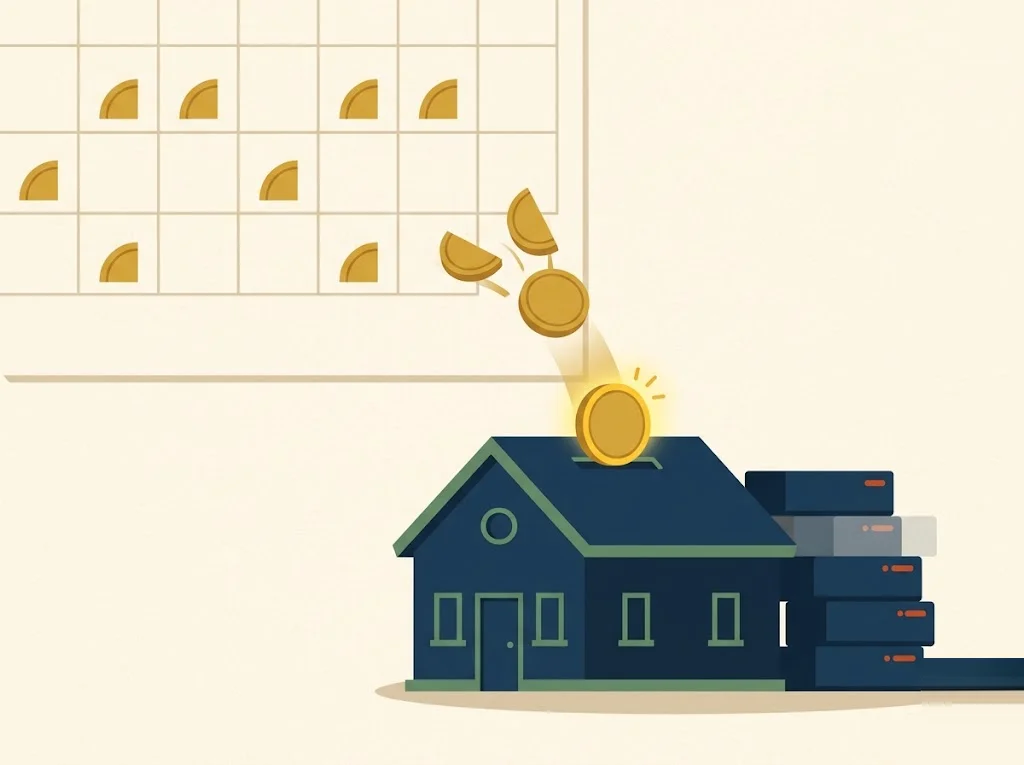
The pitch arrives stapled to your closing packet or in a glossy mailer soon after you move in: switch to biweekly mortgage payments and own your home years sooner. For once, the promise underneath the marketing is real, and the mechanism fits in one sentence. A year holds twelve months but twenty-six two-week stretches, so paying half a mortgage payment every other week adds up to thirteen full payments instead of twelve — and that quiet thirteenth payment lands entirely on principal.
What the mailer leaves out is that nobody owns this trick. It is unbranded arithmetic, free to any homeowner who can schedule a recurring transfer, yet an entire industry grew up charging hundreds of dollars to automate it. The Consumer Financial Protection Bureau, the federal consumer watchdog, eventually sued the biggest operator for selling savings its own numbers suggested most customers would never collect. Before paying anyone to set it up, it is worth seeing what the thirteenth payment is worth — and what it should cost: nothing.
Paying half your mortgage payment every two weeks produces 26 half payments a year — the equivalent of 13 full monthly payments instead of 12, with the extra one going straight to principal. On a $350,000 loan at 6.48%, that retires the mortgage in roughly 24 to 24.5 years instead of 30 and cuts total interest from about $444,000 to roughly $350,000, a saving near $90,000. The effect is pure arithmetic you can replicate for free: the company that charged up to $995 to automate it was sued by the CFPB, and its $7.93 million penalty stood when the Supreme Court declined the case in 2021.
Why 26 half payments quietly become a 13th
Start with the calendar. Fifty-two weeks divide into twenty-six two-week periods, so a biweekly schedule sends twenty-six half payments a year, and two halves make a whole: thirteen full payments over a span in which the standard schedule collects twelve. For ten months the cadence feels identical to paying monthly. Twice a year, though, a third half payment lands inside a single month — nobody writes a bigger check; the calendar does the work.
Why one extra payment matters so much is a question about amortization. A mortgage payment is fixed by formula — balance, monthly interest rate and number of payments jointly determine it — and in the early years, interest consumes most of each check. Extra money behaves differently: it bypasses interest entirely and retires principal, which means the interest that principal would have generated every month for the next two decades simply never accrues. Prepayment is compounding run in reverse, and the earlier it starts, the more months it has to work.
The industry that charged $995 for free arithmetic
Because the trick is real, it proved sellable. In May 2015 the CFPB sued Nationwide Biweekly Administration, whose “Interest Minimizer” program collected half payments from homeowners and forwarded them to mortgage servicers — for a setup fee of up to $995 plus annual processing fees of roughly $84 to $101. The Bureau’s complaint went beyond calling that expensive: it alleged the company knew most customers would pay more in fees than they would ever save in interest, because the fees land up front while the savings build slowly; by the CFPB’s account, only about a quarter of customers stayed enrolled the four-plus years needed to break even. The litigation ran for years, but the outcome held: the $7.93 million penalty became final in 2021, when the Supreme Court declined to hear the company’s appeal.
Nationwide was the headline case, not the whole market. Third-party biweekly services typically charge $200 to $400 to set up and another $2 to $5 for each payment they process, and at twenty-six payments a year the per-payment tolls alone run roughly $50 to $130. Every dollar buys something a free recurring transfer already does.
A worked example: $350,000 at 6.48%
Put numbers on it. Freddie Mac’s Primary Mortgage Market Survey put the average 30-year fixed rate at 6.48% for the week of June 4, 2026. Borrow $350,000 at that rate and the standard amortization formula — payment = balance × monthly rate ÷ (1 − (1 + monthly rate)^−360), with the monthly rate at 0.54% — produces a principal-and-interest payment of about $2,207. Carry that for thirty years and total interest comes to about $444,000 — more than the house itself cost in principal.
Now split the payment. Sending $1,103.50 every two weeks means twenty-six payments totaling $28,691 a year, against roughly $26,485 on the monthly schedule — one extra full payment of about $2,207 applied to principal annually. Feed that back through the amortization math and the loan retires in roughly 24 to 24.5 years instead of 30, while total interest falls from about $444,000 to roughly $350,000. The biweekly cadence is worth somewhere near $90,000, plus five to six years of payment-free life.
| Standard monthly | Biweekly half payments | |
|---|---|---|
| Payment | about $2,207 per month | $1,103.50 every two weeks |
| Sent per year | roughly $26,485 | $28,691 |
| Extra principal per year | $0 | about $2,207 |
| Payoff time | 30 years | roughly 24–24.5 years |
| Total interest | about $444,000 | roughly $350,000 |
Set that against the toll the sanctioned program charged — $995 up front plus roughly $100 a year, approaching $3,400 over a 24-year payoff — and the verdict writes itself. The savings belong to the arithmetic, not to the middleman.
The caveats that actually bite
The first catch is operational. Mortgage servicing is built around whole monthly payments, and some servicers will not process half of one: they park partial payments in a suspense account — a holding bucket where money sits unapplied — until enough accumulates to cover a full payment. Parked money earns you nothing and can muddy your statements, so one phone call comes before any schedule change: ask how your servicer handles partial payments.
The cleaner workaround removes the servicer’s cooperation from the equation. Divide your monthly payment by twelve — about $184 on our $2,207 example — and add that amount to every regular payment, explicitly flagged “apply to principal.” Twelve one-twelfths equal the same extra full payment per year, with no special schedule and practically the same payoff math. The flag is not decorative: unmarked extra money can be credited as an early payment toward next month, which saves you nothing.
Two neighboring levers round out the picture. If the goal is a lower required payment rather than a shorter loan, recasting the mortgage — a lump-sum principal payment followed by re-amortization — pulls in the opposite direction: same term, smaller bill. And every extra principal dollar also moves your loan-to-value ratio toward the 80% line where private mortgage insurance can come off, stacking a second saving on the first for anyone who bought with less than 20% down.
A 13th payment is math, not a product
The biweekly effect belongs to a rare category: a personal-finance trick that survives scrutiny. Twenty-six half payments are thirteen whole ones, the thirteenth compounds in your favor for decades, and the setup costs nothing beyond discipline or an automated transfer. What does not survive scrutiny is paying a toll for it: a company charged nearly a thousand dollars for what a recurring transfer does free, and its penalty survived every appeal.
If you are earlier in the chain, the same math-first lens applies before the loan exists: how to shop a US mortgage covers the rate-shopping mechanics, and the question of whether to lock a fixed rate at all deserves its own comparison. Already in the house? Run your balance and rate through our mortgage payment calculator, test what one extra payment a year does to your payoff date, and keep the $995. The thirteenth payment was always yours.
Sources
- CFPB — Suit against Nationwide Biweekly for false promises of mortgage savings (May 2015) — the Interest Minimizer program’s setup fee of up to $995, annual fees of roughly $84–$101, and the Bureau’s breakeven allegations.
- National Mortgage News — Supreme Court rejects Nationwide Biweekly petition — the $7.93 million penalty became final in 2021.
- Freddie Mac — Primary Mortgage Market Survey — 30-year fixed average of 6.48% for the week of June 4, 2026.
The worked example is illustrative, using the Freddie Mac average rate for the week of June 4, 2026; your payment, payoff date and savings depend on your balance, your rate, and how your servicer applies extra principal.
Quick answers
How much faster do biweekly payments pay off a 30-year mortgage?
About five to six years on a typical loan. The mechanism is one extra payment per year: 26 half payments equal 13 full ones, and the 13th goes entirely to principal. On a $350,000 mortgage at 6.48% — the Freddie Mac average for the week of June 4, 2026 — the monthly payment is about $2,207, and paying $1,103.50 every two weeks retires the loan in roughly 24 to 24.5 years instead of 30. Total interest falls from about $444,000 to roughly $350,000, a saving near $90,000.
Are lender biweekly payment programs worth the fee?
Rarely, because the fee buys arithmetic you can do free. The CFPB sued Nationwide Biweekly Administration in 2015 over its Interest Minimizer program, which charged a setup fee of up to $995 plus roughly $84 to $101 a year in processing fees. The Bureau alleged the company knew most customers would pay more in fees than they would save in interest, and that only about 25% stayed enrolled the four-plus years needed to break even. The $7.93 million penalty became final when the Supreme Court declined the case in 2021.
Is paying 1/12 extra each month the same as biweekly payments?
Practically, yes. Adding one-twelfth of your payment to each monthly check — about $184 on a $2,207 payment — sends the same extra full payment to principal every year, which is the entire engine of the biweekly effect. The do-it-yourself version has a real advantage: it does not depend on your servicer accepting half payments, since some park partial payments in a suspense account until a full payment accumulates. Just make sure the extra amount is explicitly marked "apply to principal," so it is not credited as an early payment toward next month.
Do I need my lender's permission to make biweekly payments?
You do not need permission to send extra principal, but you do need to know your servicer's policy on partial payments before splitting your check in half. Some servicers will not apply half payments at all — they hold them in a suspense account until a full payment's worth accumulates, which blunts the strategy and muddies your statements. One phone call settles it. If your servicer will not cooperate, skip the half payments and add one-twelfth of your regular payment to each month's check, flagged "apply to principal" — the math comes out practically identical and requires nobody's approval.
Educational content only. finbarrow is an independent editorial publication, not a licensed financial advisor, broker, tax preparer, or attorney. Verify rates and terms with the issuer or relevant regulator. See disclaimers and funding disclosures.