How your FICO score is calculated: the five weighted factors
The five factors behind your FICO score — payment history, amounts owed, length, mix, new credit — with the official weights and a worked example.
Three lenders pull your credit. Three different numbers come back. None of them is the score you saw on your bank app last week. All of them, however, are computed from the same five factors with weights Fair Isaac Corporation has published since the late 1990s and has not materially changed. Understand the five factors and the weights, and the apparent mystery of credit scoring collapses into something close to mechanical.
This guide is a working reference for the five FICO factors as they actually compute the score, with the math behind each, the practical thresholds that move scores in real terms, and a worked example of what a single 30-day-late payment does to an otherwise clean 780 FICO. Every weight and mechanic on this page is sourced to FICO’s own published documentation or to the Consumer Financial Protection Bureau; nothing here is folklore.
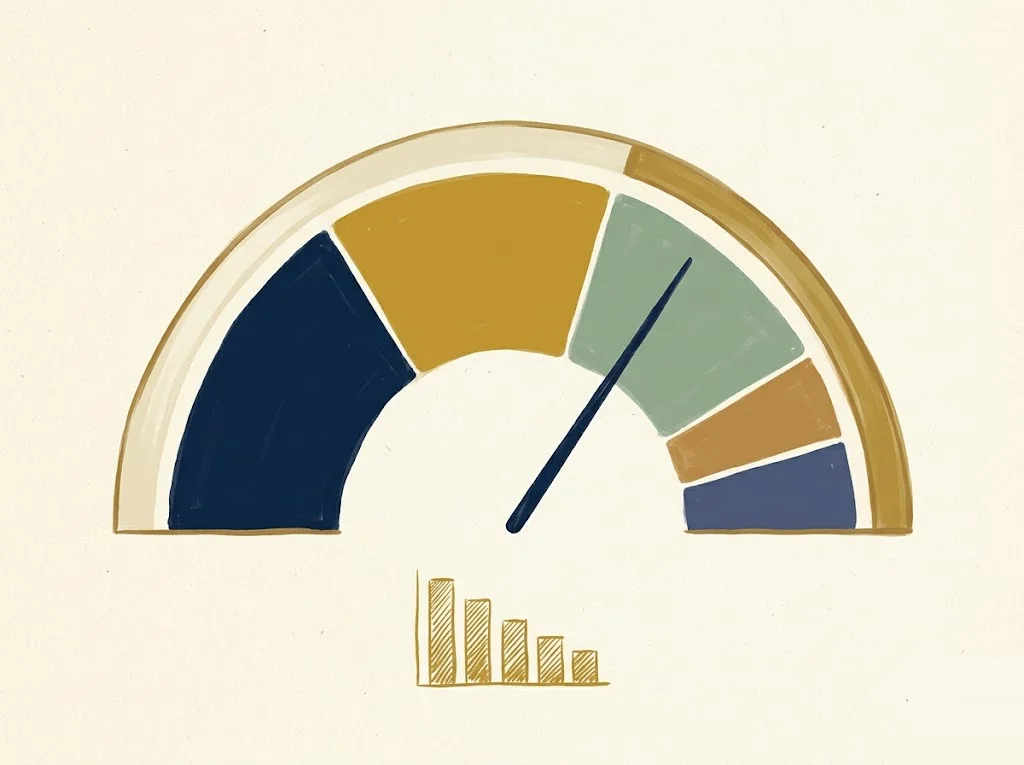
The official FICO factor weights are: payment history 35%, amounts owed 30%, length of credit history 15%, credit mix 10%, and new credit 10%. These are the figures Fair Isaac Corporation itself publishes at myFICO — What’s in your credit score, and they have held across every generic scoring generation from FICO 8 (2009) through FICO 9 and FICO 10 — the newer versions changed how medical collections and trended data are treated, not the five weights. If you are here to verify the numbers, myFICO is the primary source; the rest of this page explains what each factor actually measures and where the optimization leverage is.
The five factors at a glance
FICO has been transparent about the broad weightings since the FICO 8 generation in 2009 and has carried them forward into FICO 9 and FICO 10 with only marginal redistribution — what actually separates the three modern FICO generations is the treatment of medical debt, rental data, and trended data, not the factor weights. The published weights apply to the generic FICO score the majority of US lenders use; industry-specific variants (FICO Auto Score, FICO Bankcard Score) reweight slightly to the credit decision being made, but the same five categories are present in every model.
| Factor | FICO weight | What it captures |
|---|---|---|
| Payment history | 35% | Whether you have paid past credit accounts on time. The single largest input by a wide margin. |
| Amounts owed | 30% | How much credit you are using relative to limits — both per-account and across all revolving accounts. |
| Length of credit history | 15% | The age of your oldest account, the average age across accounts, and the age of specific account types. |
| Credit mix | 10% | The blend of revolving (credit cards) and installment (mortgage, auto, student) accounts in your file. |
| New credit | 10% | Recent inquiries, recently opened accounts, and how quickly you have opened multiple accounts at once. |
These five weights sum to 100% by construction. The interaction between them is non-additive: a perfect payment history cannot offset a 95% utilization, and a perfect 1% utilization cannot rescue a recent 60-day-late. But for the median US consumer with a typical credit file, the weights are a useful guide to where marginal optimization effort pays off.
Payment history (35%) — the factor that breaks scores fastest
Payment history is by a wide margin the largest single factor. FICO assigns it 35% of the score and the underlying logic is straightforward: the most predictive single piece of data about whether a borrower will repay a new loan is whether they have repaid previous loans on time. Lenders price risk against this directly.
The mechanics that move payment history are the late payment markers (30 days late, 60 days late, 90 days late, 120 days late, charge-off), public records (bankruptcy, tax lien — the tax lien was removed from credit files under the National Consumer Assistance Plan in 2018, but bankruptcies remain), and collection accounts. Each one of these is a hit to the score; the size of the hit depends on the starting score, the severity of the delinquency, and the recency.
A worked example illustrates the magnitude. Consider a consumer with a clean credit file and a FICO score of 780 — well into the “very good” tier, qualifying for the best advertised rates on most products. The consumer misses a single credit card payment by 31 days (a 30-day-late under FICO’s terminology). The card issuer reports the delinquency to the three bureaus on the next reporting cycle. Within a single FICO refresh, the consumer’s score typically drops 90 to 110 points, into the high 600s — a tier that no longer qualifies for the prime mortgage rate the consumer had been planning around. The drop is more severe at higher starting scores and less severe at lower starting scores, because the model penalizes more aggressively when the prior behavior was perfect; counter-intuitively, the same 30-day-late on a 620 starting score drops the score perhaps 50 to 70 points.
The late payment marker stays on the credit file for seven years from the date of the original delinquency, per the federal Fair Credit Reporting Act (CFPB — How long does negative information stay on my credit report?). The impact on the score diminishes substantially over that seven-year window — most of the score recovery happens in the first 12 to 24 months as the late payment ages — but the marker itself remains visible to underwriters until it is automatically purged.
There is essentially no optimization play on payment history. The decision rule is: pay every minimum on time, every month, on every account, without exception. Set up automatic minimum payments on every revolving account as a safety net even if you also pay manually. The cost of a single missed payment dwarfs any reward optimization on the same card.
The one structural way to add payment-history depth to a thin file without waiting years for the accounts to season is to be added as an authorized user on a long-standing account belonging to a household member or parent in good standing — the authorized-user piggybacking mechanics guide covers which issuers actually report the AU to the bureaus, which scoring models count it, and the cases where the lift is dramatic versus where it backfires.
Amounts owed (30%) — utilization, with nuance
The second-largest factor is amounts owed, which the public discussion of FICO has compressed into the phrase “credit utilization”. The compression is not wrong, but it misses two structural points that meaningfully affect scoring.
The first point is that FICO looks at both aggregate utilization (total revolving balances across all cards divided by total revolving limits) and per-card utilization (each card’s balance divided by its own limit). The aggregate is the larger input, but the per-card is independently scored. A consumer with one card at 90% utilization and four cards at 0% can score worse than a consumer with the same aggregate utilization spread evenly across five cards, even though the aggregate ratios are identical. The AZEO tactic (“All Zero Except One”) exploits this property to optimize the configuration before a major application — covered in detail in the glossary entry on AZEO.
The second point is that the relationship between utilization and score is non-linear, and the common “30% rule” reflects a defensive floor rather than the actual scoring optimum. FICO’s own published data and the empirical work the personal finance community has done with FICO simulators converge on the same conclusion: aggregate utilization below 10% scores materially better than utilization in the 10–30% band, and utilization in the 10–30% band scores better than the 30–50% band, and so on through the curve. The full pattern is examined in our deep guide on the utilization myth; the short version is that below 10% is the practical target for score-maximization, not 30%.
The mechanics of when utilization is captured matter as well. Card issuers typically report your account balance to the bureaus once per month, on or shortly after the statement closing date. The figure they report is your statement balance — what your balance was on that closing date — not your balance at any other point in the cycle. A consumer who pays the statement balance in full every month before the due date still reports the statement balance to the bureaus, which means the utilization the bureaus see can be high even though the consumer never carries an interest-bearing balance. To report a low utilization without changing your payment behavior, pay the balance down to a small fraction of the limit a few days before the statement closing date, then let the small statement balance report and pay it off after the statement issues.
The third point is that utilization is calculated only on revolving accounts — credit cards and HELOCs primarily. Installment loans (mortgage, auto, student, personal) have their own scoring treatment that tracks the original principal balance against the remaining balance, but the effect on score is materially smaller than for revolving accounts. A high mortgage balance does not drive utilization scoring in the way that a high card balance does.
Drop your current card limits and balances into the credit utilization optimizer to see your per-card and aggregate utilization side by side, plus an AZEO pay-down plan with the exact dollar amounts to clear before your next statement closes.
Length of credit history (15%) — the slow accumulator
The third-largest factor is length of credit history, weighted at 15%. The factor captures three sub-components: the age of your oldest account (the longer, the better), the average age across all accounts (the higher, the better), and the age of specific account types (lenders prefer to see seasoned accounts of the type being underwritten).
The mechanics here are slow but real. Every account on your file ages by one day each day; there is no fast lever to accelerate it. Adding new accounts dilutes the average age, which is why a consumer who opens five cards in 12 months sees their average age drop sharply even if their oldest account is unchanged. The score impact of average-age dilution is moderate, but it stacks with the new-credit factor (covered below) and amplifies the short-term cost of an opening spree.
The factor is particularly punishing for consumers building a credit file from scratch — common for recent US arrivals, young adults, and households that have historically operated on cash. The six-to-twelve month sequence that moves a thin file from “no score” to a creditworthy 680–720 is covered in the build US credit from scratch guide, including the secured-card pathway, the ITIN-versus-SSN questions, and the lenders that underwrite to thin files.
The most common mistake on this factor is closing old credit card accounts. When you close a card, the account remains visible on your file for ten years (the bureaus retain closed-in-good-standing accounts for that long), so the closure does not immediately drop your oldest-account age. The aggregate-credit limit, however, drops the moment the card is closed — and that limit reduction can spike your utilization ratio overnight, indirectly damaging the amounts-owed factor. A consumer with $30,000 of aggregate limit across three cards who closes the highest-limit card cuts their aggregate limit by perhaps $15,000; if their balances stay the same, their utilization doubles. The score impact is mediated by amounts owed, not directly by length of history.
The exception that justifies closing an old card is when the card has an annual fee and the cardholder is paying it without using the card. In that case, the math is product-specific: the annual fee out of pocket vs the potential score impact from closing. The credit utilization optimizer calculator models this trade-off explicitly. For cards with no annual fee, the default is to keep them open and use them for a single small recurring charge to keep them active.
Credit mix (10%) — the small factor most people overthink
Credit mix is weighted at 10% and captures the blend of revolving and installment accounts in your credit file. Lenders prefer to see borrowers who have managed both types of credit successfully — it indicates a broader risk profile than a borrower with only one type. A consumer with a mortgage, an auto loan, and several credit cards in good standing scores slightly better on this factor than a consumer with only credit cards.
The practical implication of the 10% weight is that credit mix matters, but not enough to drive account-opening decisions. Opening a personal loan you do not need, paying the origination fee and the interest, to add an installment account to your file is virtually never worth it on score-impact alone. The cost of the loan dwarfs the marginal score gain.
For most consumers the mix takes care of itself: a few credit cards opened over the years, a car loan once or twice over a decade, a mortgage if and when home-ownership happens, perhaps a student loan from undergraduate years. That natural mix is what the factor is trying to reward. The optimization opportunity is essentially zero; the negative case to avoid is having only credit cards (no installment history) when applying for a first mortgage — but that situation resolves itself the moment the mortgage closes.
New credit (10%) — inquiries, openings, and the 45-day window
The fifth factor, weighted at 10%, captures recent credit activity. Three sub-components feed into it: the number of recent hard inquiries on your file, the number of recently opened accounts, and the time since the most recent opening.
Each hard inquiry typically drops your FICO by two to five points for approximately twelve months, and the inquiry remains visible on your credit report for two years (CFPB). The score impact decays substantially over the twelve-month window; a hard inquiry that is six months old usually moves the score only one to two points. Multiple inquiries inside a short window stack but with a soft cap; ten inquiries in a year hurt the score more than two inquiries in a year, but not five times more.
The structural exception is rate-shopping for a single loan. FICO recognizes that a consumer shopping for a single mortgage, auto loan, or student loan will trigger multiple hard inquiries — one from each lender quoted — and treats clusters of same-type inquiries inside a window as a single inquiry for scoring purposes. The window is 45 days in FICO 8 and later. The narrower 14-day window belongs to the older Classic FICO 2/4/5 scores, the ones mortgage lenders actually pull — and because a mortgage is scored on those older models, not FICO 8, compressing rate-shopping into 14 days remains the safe target for anyone shopping a home loan. As long as you compress your rate-shopping into the relevant window for the model your lender uses, the multiple inquiries score as one. This is one of the few clean scoring optimizations available to consumers shopping for a mortgage or auto loan.
The new-account half of the factor is more punitive than the inquiry half. A newly opened account drops the average age of accounts (interacting with the length-of-history factor), introduces a fresh inquiry, and shifts the new-credit factor measurably. The effect is most pronounced when accounts are opened in clusters: opening four cards in three months hits the score harder than opening four cards over two years, even though the inquiry count is the same. The Chase 5/24 application policy — Chase denies applicants who have opened five or more credit cards in the previous 24 months — is independent of the FICO score impact but is the most visible external constraint that disciplines opening velocity. See the 5/24 glossary entry for the full mechanics.
Putting the five factors together — practical decisions
The hierarchy of optimization effort that falls out of the five weights is fairly stable across consumer profiles. In rough descending order of leverage:
- Pay every minimum, every month, no exceptions. Payment history at 35% dominates everything else. A single 30-day-late payment costs more than years of optimization elsewhere can recover.
- Keep aggregate utilization below 10% on the statement closing date. Amounts owed at 30% is the second-largest factor, and the difference between 8% and 28% utilization is roughly 20 score points for many consumers — a tier-meaningful margin.
- Do not close old credit card accounts without a specific reason. Length of history at 15% combined with the secondary effect on amounts-owed utilization makes most closures net-negative for the score.
- Compress hard inquiries for the same loan type into a 14-day window. FICO 8 and later already use a 45-day window, but a mortgage is scored on the older Classic FICO 2/4/5 models, which use the narrower 14-day window — so compressing into 14 days is the safe target whenever a mortgage might be involved. New credit at 10% rewards this directly; for mortgages and auto loans the structural saving on rate alone can dwarf the score effect, but both work together.
- Do not open accounts you do not need to manipulate credit mix. The 10% weight is too small to justify the cost of opening a loan you would not otherwise want.
The five-rule list above does not include “freeze your credit,” “pull your annual reports,” or “dispute inaccuracies” — those are credit-hygiene actions that prevent unauthorized damage rather than optimize the existing score. They are equally important and covered in the Credit section introduction, but they are not score-mechanics levers in the FICO sense.
A worked example — the cost of one missed payment
Consider a representative consumer named Sarah. Her credit file:
- Five credit cards, opened over the last twelve years, aggregate limit $40,000, current aggregate balance $2,000 (5% aggregate utilization).
- One auto loan, original balance $28,000, current balance $14,500.
- One mortgage, original balance $310,000, current balance $228,000, opened seven years ago.
- One previously paid-off student loan, closed in good standing four years ago, still visible on the file.
- No late payments in the previous seven years.
- Average age of accounts: 8.4 years.
- One hard inquiry from eleven months ago.
Sarah’s FICO 8 score in this configuration would typically fall in the 800–810 band — comfortable exceptional credit, qualifying her for the best advertised rate on any product she might apply for.
Sarah travels in March and forgets her March credit card payment. On April 5, the issuer reports a 30-day-late delinquency to the three bureaus. By April 15, the new FICO score appears at her bank: 695. A drop of approximately 110 points from a single missed payment.
The mechanism: payment history at 35% absorbs nearly all of the move. The model penalizes a clean-file consumer disproportionately for the first delinquency because it represents a sharp change in the most predictive variable. Sarah’s amounts owed, length of history, credit mix, and new credit are all unchanged; the entire move came from the 35% factor.
The recovery curve takes years. Twelve months from the delinquency Sarah’s score will likely have recovered to the mid-740s if she resumes a perfect payment history; twenty-four months in, probably mid-770s; seven years from the original delinquency, when the late payment ages off her file entirely, she will return to the 800s. The mortgage rate she could have locked in March, however, is now gone — she will not be eligible for the same advertised rate for approximately twelve to eighteen months at minimum.
The lesson is the one the 35% weight already implies, made concrete. Payment history is the dominant factor and the one with the lowest tolerance for error.
The reason these factor weights are knowable in the first place is regulatory: the Consumer Financial Protection Bureau exercises supervision and enforcement authority over the credit bureaus and the larger furnishers, and its public enforcement actions are one of the better signals of where the credit-reporting ecosystem is genuinely failing consumers. A framework for reading those enforcement actions — the categories, the typical penalty sizes, and what each one signals about future bureau behavior — is in reading CFPB enforcement actions like a practitioner.
Sources and how we cite
Every weight, threshold, and timing on this page is sourced to either FICO’s own published documentation or a federal consumer-protection source. Where folklore and primary sources diverge, we use the primary source and flag the discrepancy.
- FICO weight breakdown (35/30/15/10/10): myFICO — What’s in your credit score. Fair Isaac Corporation, publisher of the FICO model.
- Late payment retention period (7 years from original delinquency): CFPB — How long does negative information stay on my credit report?. Based on the Fair Credit Reporting Act.
- Hard inquiry retention (24 months visible, 12 months scored): CFPB — What is a credit inquiry?.
- Rate-shopping window: 45 days in FICO 8 and later; 14 days in the Classic FICO 2/4/5 scores mortgage lenders use: myFICO — Inquiries.
- Closed accounts retention (roughly 10 years for closed in good standing): a credit-bureau retention practice, not a Fair Credit Reporting Act deadline. Section 605 of the FCRA (15 U.S.C. 1681c) only limits how long negative information can be reported (generally 7 years; bankruptcies 10).
When you see a specific number in this guide — a score-drop range, a retention period, a weight — there is a citable source behind it, and that source is the authoritative one we can find. If you spot a discrepancy with another published source, please let us know and we will trace it through to the primary source and update.
Quick answers
How much does a single 30-day late payment drop my FICO?
For a consumer with an otherwise clean file in the 760–800 range, a single 30-day late typically drops the score 90 to 110 points within a single FICO refresh. The drop is more severe at higher starting scores because the model penalizes the change in behavior, not the absolute level. For a 620 file with prior delinquencies, the same 30-day late drops the score perhaps 50 to 70 points. The late payment marker stays on the file for seven years from the original delinquency date under the Fair Credit Reporting Act.
What is the practical target for credit utilization — 30% or something lower?
The widely-cited 30% rule reflects a defensive floor rather than the level that maximizes the FICO score. FICO's own published guidance and the personal finance communities' empirical work converge on the same conclusion: aggregate utilization below 10% scores materially better than utilization in the 10–30% band, and per-card utilization is independently scored alongside the aggregate. Below 10% on the statement closing date is the practical target for score-maximization.
Will closing an old credit card help my FICO?
Usually no. Closing reduces aggregate available credit, which can spike your utilization ratio overnight, and shortens average account age over time as the closed account ages off the file (closed accounts in good standing remain visible for ten years before dropping off). The negative interactions through the amounts-owed and length-of-history factors typically outweigh any benefit. The exception is when the card has an annual fee and you are not using it; in that case, the fee out of pocket may outweigh the score impact.
How long does a hard inquiry affect my FICO?
A hard inquiry typically drops the FICO by two to five points and the impact decays over approximately twelve months. The inquiry itself remains visible on the credit report for twenty-four months but is no longer scored after the first twelve. For rate-shopping on a mortgage or auto loan, the rate-shopping window groups multiple inquiries for the same loan type as a single inquiry — forty-five days under FICO 8, 9, and 10, versus fourteen days under the older Classic FICO 2/4/5 scores mortgage lenders still pull.
Educational content only. finbarrow is an independent editorial publication, not a licensed financial advisor, broker, tax preparer, or attorney. Verify rates and terms with the issuer or relevant regulator. See disclaimers and funding disclosures.