Credit-builder loans: how the backwards loan builds credit
The credit-builder loan you pay first and receive last: how a locked-savings installment loan builds a thin file, what it costs, and who it actually helps.
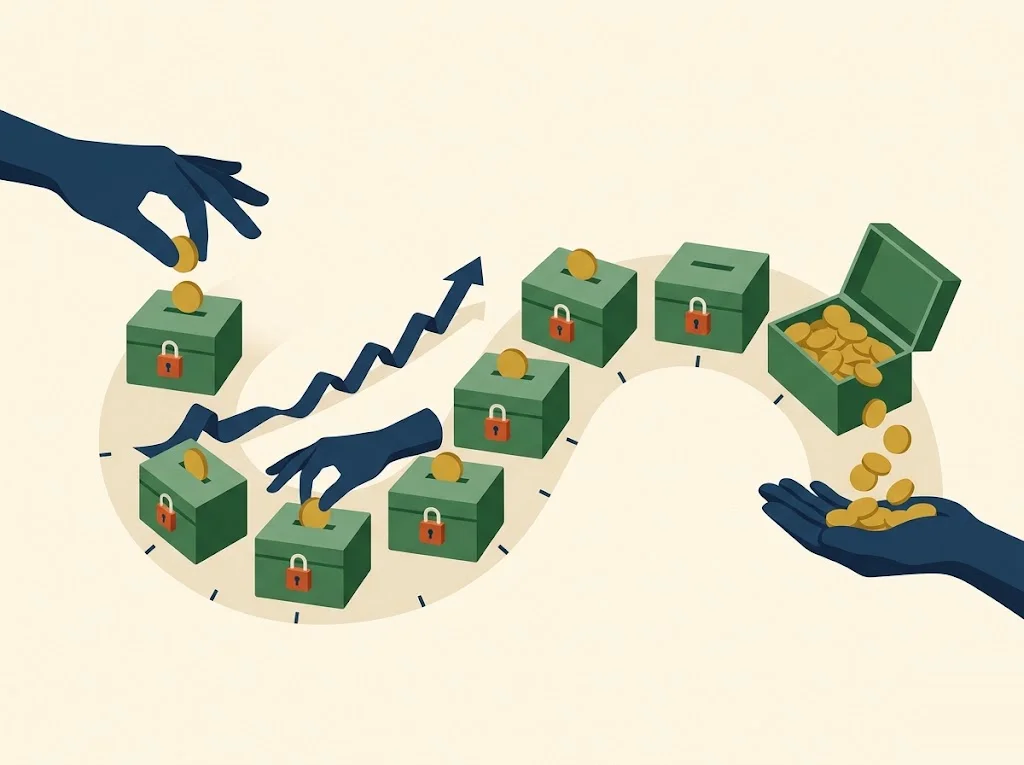
The strangest loan in American consumer finance is the one you pay off before you ever touch the money. A credit-builder loan reverses the usual order of things: instead of handing you cash and collecting it back over time, the lender approves you for a small sum — typically $300 to $1,000 — and then locks every dollar of it away in a savings account or certificate of deposit you cannot reach. You make fixed monthly payments for six months to two years, exactly as you would on a car loan, and only when the final payment clears does the lender unlock the account and give you the money that was, in a sense, yours all along.
It sounds like a trick, and the first reaction is usually to ask what the point could possibly be. The point is the paperwork. Credit unions, community development financial institutions, and fintechs such as Self and CreditStrong did not design this product to lend you money; they designed it to manufacture a payment history for someone who has none. For a borrower with no credit file or a thin one — the situation many newcomers to the United States find themselves in — that manufactured history is worth more than the cash. The loan is a machine for turning twelve disciplined payments into a credit record, and the savings it leaves behind are the bonus.
A credit-builder loan is an installment loan run backwards: the lender holds your loan amount — usually $300 to $1,000 — in a locked savings account or CD, and you pay it off over six to twenty-four months before receiving a dollar. The mechanism that matters is reporting. Each fixed payment is sent to Equifax, Experian, and TransUnion, so on-time payments build the payment history that drives your score and add an installment account to your mix. It costs modest interest and sometimes a fee, and it only works if you pay on time — every late payment is reported too.
How a backwards loan builds a credit record
A conventional loan moves money first and trust second. You receive the funds, then spend years proving you can pay them back. A credit-builder loan inverts that sequence because its borrower has not yet earned the trust a conventional lender requires. You are approved for a small amount, but the lender deposits the entire sum into a locked savings account or a certificate of deposit and keeps it there. Your monthly payments are not buying down a balance you already spent; they are slowly purchasing access to money you were never given.
What makes the arrangement worth the trouble is what the lender does each month while it waits. It reports your payment to all three major credit bureaus — Equifax, Experian, and TransUnion — and a record of on-time payments is precisely the asset a thin file lacks. Payment history is the single largest input to a FICO score, accounting for more of the number than any other factor, and a fresh borrower has nothing in that column at all. The loan also drops an installment account into your credit mix, a small diversification bonus on top of the payment record. By the time the term ends, you have built the one thing a credit card statement or a rent-reporting service or authorized-user arrangement might take longer to establish: a clean, bureau-reported run of repayments in your own name.
A worked example: $600 over twelve months
Picture a borrower — call him Marcus — who arrived in the country eighteen months ago and cannot yet qualify for an unsecured card. He opens a $600 credit-builder loan with a twelve-month term. The lender immediately moves $600 into a locked account he cannot withdraw from, and Marcus begins paying roughly $52 a month. Each of those twelve payments is reported to the three bureaus. When the final one clears, the lender unlocks the account and returns about $600 to him, having charged modest interest along the way.
At the end of the year Marcus has two things he did not have before: a $600 nest egg he was forced to save, and a twelve-month payment history attached to his name at every bureau. The numbers below are illustrative — actual interest, fees, and payment amounts vary by lender — and they sit next to the obvious alternative so the trade-off is visible.
| Feature | Credit-builder loan (illustrative) | Secured credit card (illustrative) |
|---|---|---|
| Up-front money required | None at approval; pay ~$52/month | Refundable deposit (e.g. $200–$600) |
| What you get back | ~$600 at the end, plus interest, minus fees | Your deposit back when you close or upgrade |
| Account type | Installment (fixed term) | Revolving (open-ended line) |
| Net cost | Modest interest + possible monthly/admin fee | Often near zero on a no-fee card paid in full |
| How it reports | Monthly payments to all three bureaus | Balance and payments to all three bureaus |
| Builds credit? | Yes | Yes |
The honest takeaway from the table is that both tools build credit, so the decision is not about which one works. It is about cost and shape: the loan charges a small fee for the discipline of forced savings and an installment tradeline, while a secured card can be cheaper and gives you a revolving line you actually use. If you already understand how revolving credit behaves, building a deliberate credit-card stack may serve you better than a loan that locks your cash away.
What it costs to rent a positive tradeline
Nothing about this product is free, and pretending otherwise is how people end up disappointed. Most credit-builder loans charge interest, and many add an administrative or monthly fee on top, so the loan carries a real net cost even though you eventually get your principal back. You are essentially paying a small rental fee for a positive tradeline and a savings commitment you cannot easily break. On a modest loan that cost is usually small in absolute dollars, but it is not zero, and it deserves to be measured against the alternative rather than waved away.
That alternative is the secured credit card, which asks for a refundable deposit instead of a stream of payments and, on a no-fee card paid in full each month, can build credit at essentially no net cost. The credit-builder loan justifies its price in two situations: when you want the installment account that a card cannot provide, and when the forced-savings structure is the feature rather than the bug — money you genuinely cannot touch until the term ends is money you cannot spend on a bad week. Weigh the total interest and fees against a secured card’s economics before you sign, because the cheaper path is not always the one that fits your habits.
The caveats that actually bite
The caveat that undoes more credit-builder loans than any other is the assumption that the reporting only flows one way. It does not. A late payment is reported to Equifax, Experian, and TransUnion with exactly the same diligence as an on-time one, which means a missed month does not merely fail to help — it actively damages the score you opened the loan to build. The product is a tool for people who can pay on time every single month, and it punishes anyone who cannot. Before committing, be honest about whether the fixed payment fits comfortably inside your budget, because the worst outcome here is a brand-new derogatory mark on a file you were trying to repair.
The second caveat is subtler and concerns who benefits at all. The marginal value of a credit-builder loan depends entirely on how empty your file already is. A borrower with no credit history gains a great deal, because the loan supplies the payment record that nothing else in their life is generating. A borrower who already holds one or more credit cards that report every month is layering a small, paid-for tradeline on top of accounts that are already doing the same job, and will see little to show for the interest and fees. If your cards are already reporting, the money is better spent elsewhere.
Who should use one
A credit-builder loan earns its keep for a narrow but real audience: someone with no credit file or a thin one, who cannot yet qualify for a credit card or would rather not carry one, and who can comfortably afford the monthly payment without strain. That describes a great many recent immigrants, young adults who have never borrowed, and people rebuilding after a file went dormant — borrowers for whom the central problem is the absence of any payment history at all. For them, the loan does something almost nothing else does cheaply: it conjures a clean, bureau-reported track record out of a savings habit, and it hands back the savings at the end.
For everyone else, the case is weaker. If you already have cards reporting on-time payments to the bureaus, a credit-builder loan adds cost without adding much signal, and your dollars do more elsewhere. The product is not a score-hacking shortcut and it is not magic; it is a disciplined way to build a first track record, priced as such. Used by the right borrower, paid on time without exception, it turns twelve small payments into the foundation of a credit file — and that foundation, once laid, is what the rest of your financial life gets built on.
Sources
- Consumer Financial Protection Bureau — What is a credit-builder loan? — definition of the locked-savings installment structure, the role of bureau reporting, and the on-time-payment requirement.
- CFPB — Targeting credit builder loans (research brief) — evidence on how credit-builder loans affect scores for borrowers with and without existing debt.
- Experian — What is a credit-builder loan? — how the locked-savings mechanism reports monthly payments to the three major bureaus, and how it compares with a secured credit card.
Figures in this article are illustrative; actual loan amounts, interest, fees, and payment sizes vary by lender, and a credit-builder loan only builds credit if every payment is made on time.
Quick answers
How does a credit-builder loan actually build credit?
The mechanism is the monthly reporting, not the money. The lender holds your loan amount in a locked savings account or certificate of deposit and reports each fixed payment to Equifax, Experian, and TransUnion. Every on-time payment adds to your payment history, which is the single largest input to a credit score, and the loan itself adds an installment account to your credit mix. You are building a track record of repayment while the cash sits untouched, and you collect it only once the loan is paid off.
Will I get my money back from a credit-builder loan?
Yes — that is the whole design. The lender releases the full amount once you finish the term, plus any interest the locked account earned, minus any fees the lender charged. On an illustrative $600 loan over twelve months you would receive roughly $600 back at the end, having effectively forced yourself to save while building a year of payment history. The net cost is the interest and any administrative fee, which is the small price you pay to rent a positive tradeline and build a savings habit at the same time.
Can a credit-builder loan hurt my credit score?
It can, and this is the risk that matters most. A late payment on a credit-builder loan is reported to the bureaus exactly the same way an on-time payment is, so a missed month damages the very score you are trying to build. The product only helps if you pay on time, every single time. That is why it suits someone who can comfortably afford the fixed monthly payment, and why you should never take one larger than your budget can absorb without strain.
Is a credit-builder loan or a secured credit card better?
Both build credit, so the choice comes down to cost and structure rather than effectiveness. A secured credit card requires a refundable deposit, gives you revolving credit you can use, and is often cheaper because a no-fee secured card can carry no net cost if you pay in full. A credit-builder loan charges interest and sometimes a fee, but it adds an installment account to your mix and forces a savings habit you cannot easily raid. Compare the total fees against a secured card before deciding, and pick the structure that matches how you handle money.
Educational content only. finbarrow is an independent editorial publication, not a licensed financial advisor, broker, tax preparer, or attorney. Verify rates and terms with the issuer or relevant regulator. See disclaimers and funding disclosures.