Credit limit reallocation: move limits between cards, by issuer
Shift a credit limit between cards at the same issuer with no new hard pull — Chase Credit Line Exchange, Capital One's rollout, and the utilization math.
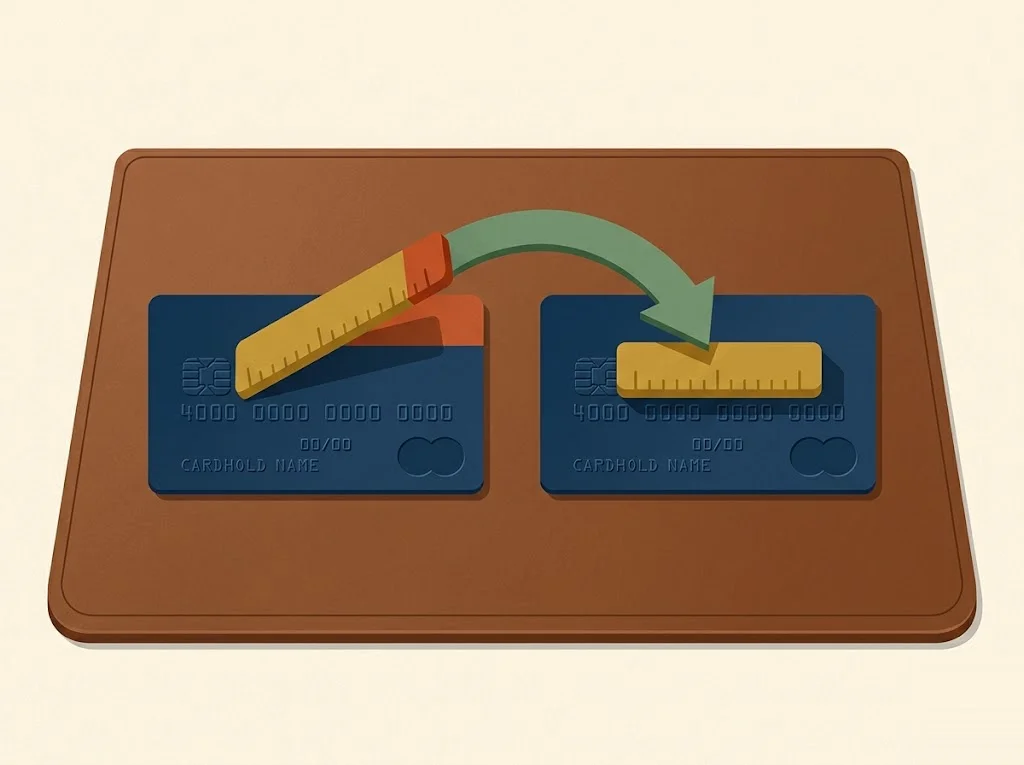
The short answer. Credit limit reallocation — sometimes called a credit line transfer or exchange — means moving part of a credit limit you already have from one card to another card you hold with the same issuer, without applying for new credit. Because you are redistributing room you already own rather than asking for more, it is typically a soft credit check or no check at all, unlike a credit limit increase, which can be a hard pull at some issuers. Chase offers it as an official feature called Credit Line Exchange, Capital One has been rolling out an online version for eligible accounts, and most other issuers vary — so confirm the rules on your issuer’s site before you count on it.
What reallocation actually is — and what it is not
Reallocation does one specific thing: it shifts a slice of your existing credit limit from one card to another at the same issuer. The total amount of credit that issuer extends to you does not move. If you carry two cards from the same bank and one has a $4,000 limit while the other has a $4,000 limit, reallocation might leave you with, say, more room on one and less on the other — but the combined figure stays put. That is the whole point of separating it from a credit limit increase. A reallocation rebalances; an increase grows the pie.
This distinction matters most for the inquiry on your credit file. A credit limit increase request can land as a hard pull at some issuers, the kind of inquiry that dings your file and that we cover in soft versus hard pulls. Reallocation, by contrast, is usually a soft move or no check at all. You are not borrowing more, so the lender often does not need to re-underwrite you. That makes it a quietly useful tool when you want to fix a problem on one card without the cost of opening a new account or absorbing a fresh inquiry.
Chase: Credit Line Exchange
Chase formalizes this as a feature it calls Credit Line Exchange, and it even publishes a walkthrough titled “A Guide to Credit Limit Transfers.” You can move a limit between your Chase cards online with no credit check — no hard pull — which is about as clean as this gets.
The rules are specific. Transfers happen between cards of the same type only: personal-to-personal or business-to-business, but never between a personal Chase card and a business Chase card. Both the card you are moving credit from and the card you are moving it to must be open and in good standing, so you cannot pull a limit out of a closed, canceled, or restricted account, nor push one into a card in that state. And the amounts are quantized — transfers must be at least $100 and move in $100 increments, so you adjust in clean blocks rather than to the dollar. These terms were last verified June 2026 and, like everything in this space, can change.
Capital One and everyone else
Capital One historically did not let cardholders reallocate limits online at all. More recently it has been rolling out the ability to consolidate or reallocate credit limits online — and to close cards — for eligible accounts, and when it runs, that process results in a soft pull rather than a hard one. The catch is the word “eligible”: availability varies from account to account and the feature is still evolving, which is why we seal it as last verified June 2026. Check your own account online; do not assume the option is live just because someone else reports having it.
Beyond Chase and Capital One, the picture is genuinely all over the map. Some issuers allow reallocation by phone, some not at all, and the specifics shift over time — so treat anything you read, here included, as a June 2026 snapshot rather than a permanent rule. The reliable move is to verify on your issuer’s own site or by calling the number on the back of your card. If an agent or a help page tells you the limit is movable, ask plainly whether it triggers a hard pull, a soft pull, or no check, because that answer is the entire reason to prefer reallocation over an increase.
The utilization math
The reason cardholders reach for reallocation is usually a single card running hot. Credit scoring looks at utilization two ways: the ratio on each individual card, and your aggregate utilization across all your lines. A card that is close to its limit drags on the per-card measure even when your overall numbers look fine — a nuance we unpack in the utilization myth. Moving a chunk of limit onto that hot card lowers its utilization ratio without a new inquiry, which can help, because the per-card figure is one of the inputs.
Here is the part people miss. Reallocation does not change your aggregate utilization with that issuer, because the total limit is unchanged — you have only altered the split. So if your problem is overall utilization, reallocation alone will not fix it; for that you need either a real increase in total credit or a lower balance. Where reallocation shines is the per-card case, and it pairs naturally with the optimization tactic of carrying a small balance on exactly one card, which we explain in AZEO, all zero except one. Reshuffling room onto the one reporting card, or off the cards you want at zero, gives you finer control over how each line looks on your report.
Which tool for which goal
The decision frame is simple once you separate the two outcomes. If you only need to rebalance utilization between cards, or to put more room on a newer card so you can use it harder, and you would rather not take on new debt or a new inquiry, reallocation is the soft, no-new-debt move. It costs you nothing on your credit file at the issuers above and asks for nothing in return.
If, on the other hand, you genuinely need more total credit with that issuer — a higher combined ceiling, not a different split — then reallocation cannot deliver it. That is a credit limit increase request, and depending on the issuer it may come with a hard pull. The two are different tools for different jobs: one reshuffles what you already have, the other tries to grow it. Decide which problem you actually have, confirm the current rules on your issuer’s site since this is a June 2026 snapshot, and pick accordingly.
Quick answers
Does moving a credit limit between my cards trigger a hard pull?
Usually not. At Chase, a Credit Line Exchange between two of your Chase cards runs with no credit check at all. At Capital One, the online consolidation that has been rolling out to eligible accounts results in a soft pull. That is the core appeal of reallocation versus a credit limit increase, which can be a hard pull at some issuers. This reflects issuer terms last verified June 2026.
Will reallocation lower my overall credit utilization?
No. Reallocation does not change your aggregate utilization with an issuer, because your total limit there is unchanged — it only changes how that limit is split between cards. It can lower the utilization ratio on one specific card by moving room onto it, which helps because scoring looks at both per-card and overall utilization.
Can I reallocate a limit between a personal and a business Chase card?
No. Chase's Credit Line Exchange allows transfers between cards of the same type only — personal-to-personal or business-to-business — but not between a personal and a business card. Both cards must also be open and in good standing.
What are the dollar rules for a Chase Credit Line Exchange?
Chase requires transfers of at least $100, made in $100 increments, and both the sending and receiving accounts must be open and in good standing — you cannot move a limit to or from a closed, canceled, or restricted account. These terms were last verified June 2026.
Educational content only. finbarrow is an independent editorial publication, not a licensed financial advisor, broker, tax preparer, or attorney. Verify rates and terms with the issuer or relevant regulator. See disclaimers and funding disclosures.