Qualified charitable distributions: give from your IRA, skip the tax
A QCD lets anyone 70½+ donate straight from an IRA: the gift never touches your AGI — better than a deduction — and from 73 it satisfies your RMD. 2026 rules.
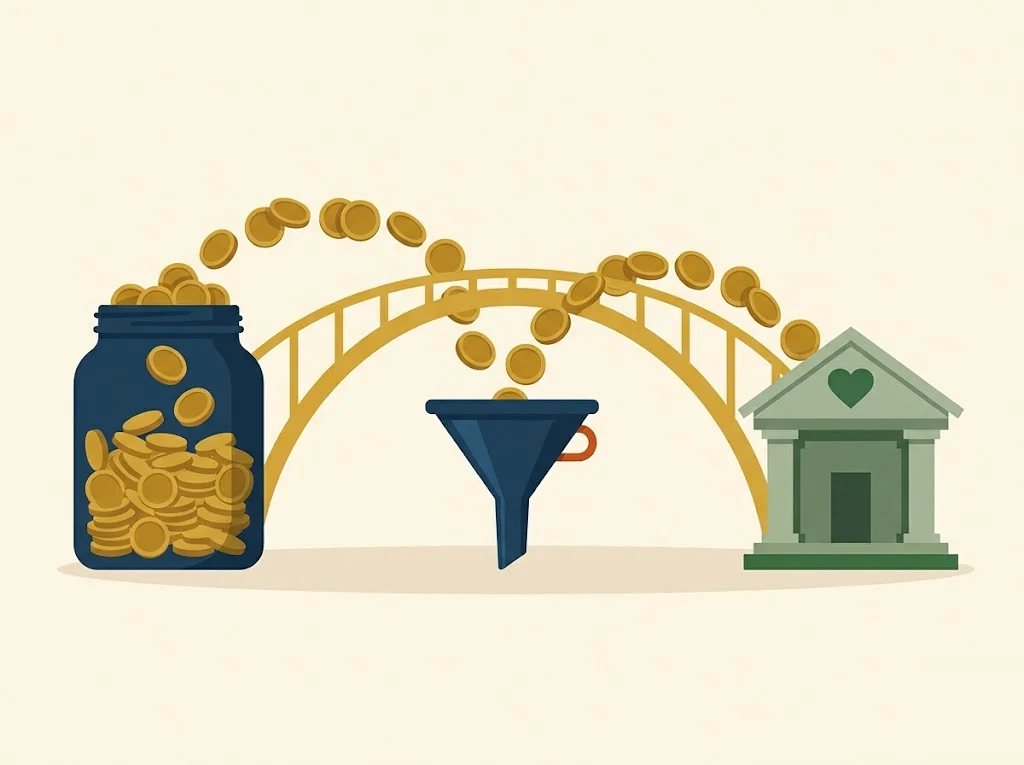
Most retirees who give to charity get no tax benefit for it. The reason is mundane: the charitable deduction only works if you itemize, and most retired households take the standard deduction instead. The checks they write to the church, the food bank, or the alma mater are generous — and, from the IRS’s point of view, invisible. Meanwhile those same households often sit on traditional IRAs that grow quietly toward a future tax bill.
There is a channel built for exactly this situation, and it opens at age 70½. The qualified charitable distribution — QCD from here on — lets you send money from your individual retirement account directly to a charity, skipping your tax return entirely. Done right, it beats donating cash in almost every measurable way, and from age 73 it can absorb the withdrawal the IRS forces you to take anyway.
A qualified charitable distribution lets anyone 70½ or older send up to $111,000 a year (2026) directly from an IRA to a public charity. The gift is excluded from income — it never raises your adjusted gross income — it works alongside the standard deduction, and from age 73 it counts toward your required minimum distribution.
How a qualified charitable distribution works
The mechanics are strict but short. A QCD travels directly from your IRA custodian to the charity — trustee to charity, with no stop in your checking account along the way. If the custodian cuts the check to you and you pass the money along yourself, the special treatment is gone: under IRS Publication 590-B, that sequence is just an ordinary taxable withdrawal followed by an ordinary donation.
The account matters as much as the route. QCDs can only come from IRAs — a traditional IRA, an inherited IRA, or a SEP or SIMPLE IRA that is no longer receiving employer contributions — and never from a workplace plan such as a 401(k). You must actually have reached age 70½ when the money goes out, not merely turn 70½ later that year. And the recipient must be a public 501(c)(3) charity: donor-advised funds, private foundations, and supporting organizations are specifically excluded, a detail that catches donors who run all their regular giving through a donor-advised fund.
The ceiling, on the other hand, is generous. In 2026 you can give up to $111,000 per person, up from $108,000 in 2025, because the SECURE 2.0 Act tied the cap to inflation. The limit belongs to the individual, not the household, so in a married couple each spouse who qualifies can send $111,000 from his or her own IRA. Layered on top is a separate one-time election: up to $55,000 in 2026 can go in a single QCD to a charitable remainder trust or a charitable gift annuity, split-interest vehicles that pay you an income stream for life and leave the remainder to charity. Both caps are indexed on the same CPI window as the tax brackets, so the 2027 figures are already settled at $114,000 and $57,000, months before the IRS prints them (the 2027 QCD limit, worked out).
Why excluding income beats deducting it
Here is the heart of the case. A normal charitable gift funded from an IRA happens in two taxable steps: you withdraw, the withdrawal lands in your income, and then — only if you itemize — a deduction claws part of it back. A QCD collapses the two steps into none. The distribution is excluded from gross income altogether, so it never appears in your adjusted gross income, the running total Form 1040 builds line by line.
That placement is worth real money, because adjusted gross income is the number the rest of the tax system keys off. A lower AGI can shrink the income-related monthly adjustment amount — IRMAA — that sets your Medicare premium surcharges, reduce how much of your Social Security benefit is taxable, and keep you under the many thresholds pegged to AGI or to modified adjusted gross income (MAGI). An itemized deduction, by contrast, arrives downstream, after all of those gates have already been measured. Exclusion is upstream medicine.
There is a humbler advantage too: the QCD works even if you take the standard deduction — which most retirees do, since the standard-versus-itemized comparison usually settles itself quickly in retirement. A cash gift earns a tax benefit only if your itemized deductions clear the standard deduction, which is why some donors resort to bunching several years of gifts into one. A QCD needs no such gymnastics; the exclusion applies no matter which deduction you take. The single prohibition is double-dipping: dollars excluded as a QCD cannot also be claimed as a charitable deduction.
The 70½-to-73 window almost nobody uses
A common misreading ties QCDs to required minimum distributions. The two are separate clocks. The QCD age is exactly 70½, while required minimum distributions — RMDs, the withdrawals the IRS eventually forces out of pre-tax accounts — now begin at age 73 under the SECURE 2.0 Act, rising to 75 in 2033. The gap between those two ages is an opportunity hiding in plain sight.
Between 70½ and 73, you can make QCDs from an IRA that does not yet owe any RMD at all. Every dollar given in that window permanently leaves the pre-tax balance — the traditional-IRA money that has never been taxed and will one day be forced out as taxable income. Decades of contributions at steadily rising limits compound into the balance on which every future RMD is calculated; shrink that base early and every RMD for the rest of your life shrinks with it. For someone who plans to give to charity anyway, front-loading the gifts into the 70½-to-73 window quietly defuses the RMD problem before it exists.
From 73 on, sequence matters: QCD first, RMD second
Once RMDs do begin, the QCD picks up its second job: it counts toward your required minimum distribution for the year, up to the annual limit. Give at least as much as your RMD and the requirement is fully satisfied — with not a dollar of it landing on your return as income.
But the order of operations matters, because of a quirk in how the requirement is credited: the first money out of your IRA each year is deemed to count toward the RMD. Take your full RMD in cash in February and decide on a QCD in October, and the gift cannot retroactively offset what you already withdrew — that February distribution is taxable income, permanently. The operating rule is simple. In any year you plan both, make the QCD first, then take whatever you still need afterward.
Paperwork, the December deadline, and the golden rules
The reporting trips people up because the custodian will not do it for you. The Form 1099-R you receive reports the full distribution with no special QCD marking; it is on you — or your preparer — to report the total on line 4a of Form 1040, exclude the QCD portion from line 4b, and write “QCD” next to it. Keep the charity’s written acknowledgment letter in the same folder, because the IRS expects you to have one.
The deadline carries its own trap. A QCD counts for the year only when the charity actually has the money: a check written from an IRA checkbook that is not cashed by December 31 does not count for that year. Custodian-initiated transfers are the safer route, and November is the sensible month to start one — not the week between Christmas and New Year’s.
The golden rules, then, fit in a breath. Give directly, custodian to charity, never through your own hands. Give from an IRA, not a 401(k). Give before you withdraw, so the gift counts toward the RMD rather than after it. Give to a real public charity, not a donor-advised fund. Finish early enough for the money to land by December 31, keep the acknowledgment letter, and never deduct what you already excluded. Follow those, and you will have found the rare corner of the tax code where generosity and self-interest point in exactly the same direction.
Sources
- IRS — Publication 590-B, Distributions from Individual Retirement Arrangements — QCD mechanics: the 70½ age requirement, the trustee-to-charity transfer, eligible IRA types and charities (including the exclusion of donor-advised funds, private foundations, and supporting organizations), the no-double-dip rule, and Form 1040 line 4a/4b reporting.
- Congress.gov — CRS, Qualified Charitable Distributions from IRAs (IF11377) — statutory background, including the SECURE 2.0 Act provisions that index the QCD cap to inflation and created the one-time split-interest election.
- IRS — Notice 2025-67 — the 2026 QCD limit of $111,000 (up from $108,000) and the one-time split-interest election limit of $55,000 (up from $54,000).
- Fidelity — Qualified charitable distributions (QCDs) — the RMD beginning age of 73 (rising to 75 in 2033), eligible accounts, and the one-time election to fund a charitable remainder trust or charitable gift annuity.
- Charles Schwab — Reducing RMDs With QCDs in 2026 — the 2026 per-person limit of $111,000, how a QCD offsets the year’s RMD, and the first-dollars-out ordering rule.
Dollar limits are the 2026 inflation-indexed amounts and will adjust in future years; how much a lower AGI actually saves you depends on your Medicare bracket, your Social Security mix, and your state’s tax treatment.
Quick answers
How much can I give as a QCD in 2026?
The 2026 limit is $111,000 per person, up from $108,000 in 2025, because the SECURE 2.0 Act indexed the cap to inflation. The limit is individual rather than per household: in a married couple, each spouse who is 70½ or older can give up to $111,000 from his or her own IRA. On top of that sits a separate once-in-a-lifetime election of up to $55,000 that can fund a charitable remainder trust or a charitable gift annuity — a split-interest gift that pays you an income stream and leaves the remainder to charity.
Can I make a qualified charitable distribution from my 401(k)?
No. Qualified charitable distributions only work from IRAs — a traditional IRA, an inherited IRA if the beneficiary has reached 70½, or a SEP or SIMPLE IRA that is no longer receiving employer contributions. Workplace plans such as a 401(k) are excluded regardless of your age. If most of your pre-tax savings sit inside a 401(k), the money would first need to be rolled into an IRA before any of it could travel to charity as a QCD, so that move is worth planning well before the year you intend to give.
Does a QCD still help if I take the standard deduction?
Yes — and that is precisely the point. A QCD is an exclusion from income rather than an itemized deduction, so it lowers your adjusted gross income whether or not you itemize. Most retirees take the standard deduction, which means an ordinary cash donation earns them no tax benefit at all; the same dollars sent as a QCD escape tax completely. The one restriction is that you cannot double-dip — money excluded from income as a QCD cannot also be claimed as a charitable deduction.
Can I send a QCD to a donor-advised fund?
No. The recipient must be a public charity — a 501(c)(3) organization eligible to receive tax-deductible gifts — and the rules specifically exclude donor-advised funds, private foundations, and supporting organizations. The money must also travel directly from your IRA custodian to the charity, and the charity has to receive it in time: a check written from an IRA checkbook that goes uncashed by December 31 does not count for that year. Ask the charity for a written acknowledgment letter and keep it with your tax records.
Educational content only. finbarrow is an independent editorial publication, not a licensed financial advisor, broker, tax preparer, or attorney. Verify rates and terms with the issuer or relevant regulator. See disclaimers and funding disclosures.