Form 1099-INT box by box: where each box lands on your return
What Form 1099-INT boxes 1, 2, 3, 8 and the rest mean, where each flows on your 1040, and the state-tax break on box 3 most filers miss.
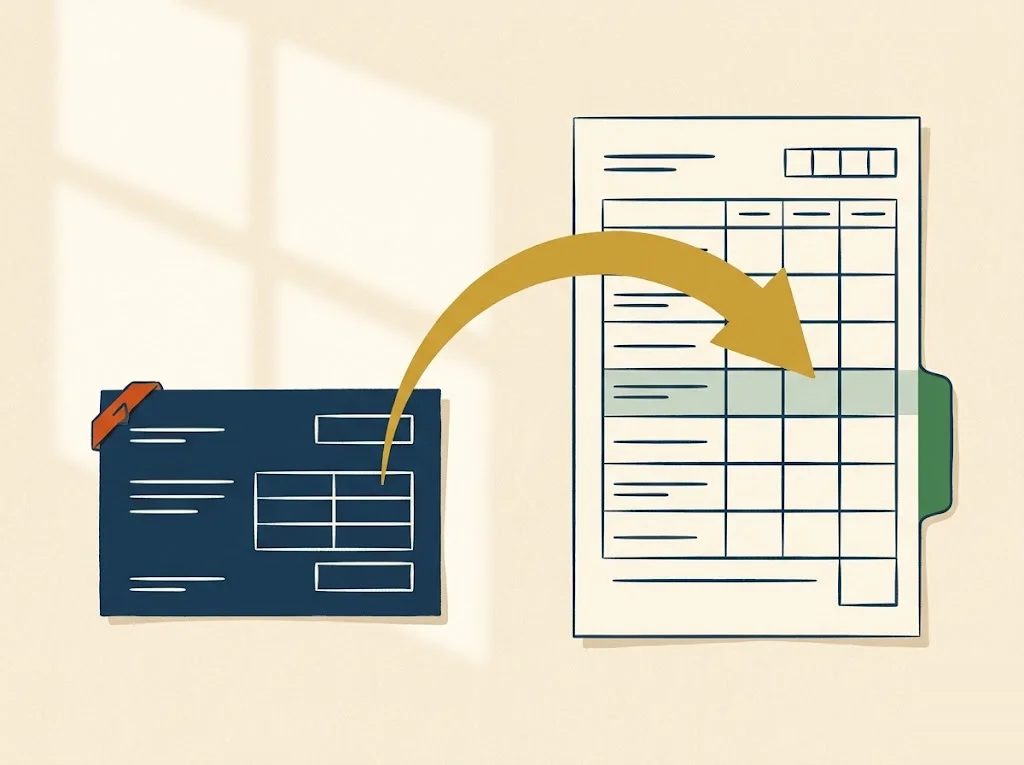
The short answer. Form 1099-INT reports the interest your bank, broker, or the US Treasury paid you, and almost every box maps to a specific line on your return rather than to a single “interest” bucket. The big ones, boxes 1 and 3, both end up as taxable interest on Form 1040, line 2b (routed through Schedule B when your total runs high enough), but box 3 carries a state-tax exemption that box 1 does not. The boxes that trip people up are box 2, an early-withdrawal penalty you deduct separately, and box 8, tax-exempt interest that never touches Schedule B at all.
Why the form is sliced into boxes in the first place
It would be simpler if a 1099-INT had one number on it. Instead the form spreads your interest across several boxes, and the reason is that the United States tax code treats different flavors of interest differently. Some interest is fully taxable everywhere. Some is taxable federally but shielded from your state. Some is not taxable income at all but still has to be disclosed. And one box is not income at all but a payment you already made toward your tax bill. The payer cannot know your state or your filing situation, so it sorts the dollars into the categories the law cares about and leaves the routing to you.
That routing is the whole game. Get a box into the wrong line and you either overpay, underpay, or hand the IRS a return that does not reconcile against the copy the payer already filed. Before any of this matters, one ground rule: a payer generally must send you a 1099-INT once your interest hits $10, or $600 when the interest is paid in the course of a trade or business. But the form is a courtesy, not the trigger. (That $600 business-interest figure comes from section 6041, which the 2025 tax law raised to $2,000 for payments made after 2025; the IRS instructions for Form 1099-INT, last revised January 2024, still print $600, so expect them to change.) You owe tax on taxable interest whether or not a 1099-INT ever lands in your mailbox.
The boxes that become taxable interest
Two boxes drive the headline number on your return. Box 1, interest income, is ordinary taxable interest that did not come from the US Treasury or savings bonds, the everyday yield from a checking account, a high-yield savings account, or a certificate of deposit (CD). The form’s own instruction for box 1 is to “enter taxable interest not included in box 3.” It flows onto Schedule B, Part I, and totals up to Form 1040, line 2b, taxable interest.
Box 3, interest on US Savings Bonds and Treasury obligations, covers Treasury bills, notes, and bonds. On your federal return it behaves exactly like box 1: it lands on Schedule B, Part I, and rolls into line 2b. The difference shows up on your state return, and it is the most overlooked break on the entire form.
That is the legal basis, 31 U.S.C. 3124(a), and it is precisely why the payer separates box 3 from box 1. The federal government taxes the interest; your state and your locality cannot. When you file your state return, box 3 interest gets subtracted out. Filers who sweep box 1 and box 3 into one figure quietly overpay state tax every year they hold Treasuries, which is no small thing if you have been parking cash in T-bills.
The early-withdrawal trap in box 2
Box 2, early withdrawal penalty, is the interest or principal you forfeited for cashing a CD before it matured. The instinct is to subtract it from the interest you earned, and the instinct is wrong. The IRS spells it out: do not reduce the amount reported in box 1 by the amount of the forfeiture. You report your box 1 interest in full as income, and then you take box 2 separately as a deduction.
It is a good deduction to have, because it sits above the line. Box 2 goes on Schedule 1 (Form 1040), line 18, “penalty on early withdrawal of savings,” and that reduces your adjusted gross income (AGI) directly, no itemizing required. AGI is the figure a long list of other tax provisions keys off, so shaving it down has reach well beyond this one line. Net box 2 against box 1, and you have thrown that deduction away while also reporting too little income, a mistake in both directions at once.
The boxes that never touch Schedule B
Not everything on the form is income, and not everything that is income belongs on Schedule B.
- Box 4, federal income tax withheld, is backup withholding, money already pulled from your interest, typically because you did not furnish a taxpayer identification number to the payer. This is not income; it is a payment. It flows to Form 1040, line 25b, as a withholding credit against whatever you owe.
- Box 8, tax-exempt interest, is municipal bond interest. It is not taxable interest, so it does not go on Schedule B as taxable, and it does not flow to line 2b. It is reported on Form 1040, line 2a, tax-exempt interest, for information only. Crucially, because it is not taxable interest, box 8 does not count toward the $1,500 that forces you onto Schedule B.
- Box 9, specified private activity bond interest, is a subset of box 8. It is exempt for regular tax but counts as a preference item for the alternative minimum tax (AMT), so it carries over to Form 6251.
- Boxes 11 and 13, bond premium, are amounts that offset the interest you report, box 11 on a covered taxable bond and box 13 on a tax-exempt bond. They reduce the interest figure rather than adding to it.
The thread running through these is that a box’s label tells you almost nothing until you ask which line it maps to. Box 4 looks like it should matter for income and does not. Box 8 looks like interest and is, but not the taxable kind.
When Schedule B actually comes into play
All of this box-sorting only forces an extra form when your taxable interest gets large enough. Schedule B is required once your taxable interest runs over $1,500, and the full mechanics of that threshold, including how it interacts with dividends, live in our guide on Schedule B and the $1,500 threshold. The point worth carrying here is what counts and what does not: box 1 and box 3 count toward the $1,500, because both are taxable interest, while box 8 tax-exempt interest does not count toward it at all. A portfolio heavy in munis can throw off real income and still leave you under the threshold.
If your 1099-INT arrived alongside a 1099-DIV, the dividend form follows the same logic of slicing one payment into legally distinct boxes, ordinary versus qualified dividends, capital gain distributions, and so on. The box-by-box walkthrough for that sibling form is in our breakdown of the 1099-DIV boxes, and reading the two together is the fastest way to internalize the habit the IRS is quietly demanding of you. The form is not a total. It is a set of instructions, and each box is telling you where to go.
Quick answers
If I cashed a CD early, can I just subtract box 2 from box 1?
No, and this is the single most expensive mistake on the form. The IRS instruction is explicit: do not reduce the amount reported in box 1 by the amount of the forfeiture. You report the full box 1 interest as income, then take the box 2 early-withdrawal penalty separately as an above-the-line deduction on Schedule 1 (Form 1040), line 18. Netting them deprives you of a deduction that lowers adjusted gross income.
Why is the interest in box 3 separated from box 1?
Box 3 is interest on US Savings Bonds and Treasury obligations (Treasury bills, notes, and bonds). It is fully taxable on your federal return, but it is exempt from state and local income tax under 31 U.S.C. 3124(a). The payer breaks it out so your state return can subtract it. If you lump it in with box 1, you overpay state tax.
Does my tax-exempt interest in box 8 count toward the $1,500 Schedule B threshold?
No. Box 8 reports municipal bond interest, which is not taxable interest. It is reported on Form 1040, line 2a for information only and never appears on Schedule B as taxable. Because it is not taxable interest, it does not count toward the $1,500 that triggers the Schedule B filing requirement.
I earned interest but never received a 1099-INT. Do I still owe tax?
Yes. A payer generally must issue Form 1099-INT once interest reaches $10 (or $600 paid in the course of a trade or business), but the obligation to report taxable interest does not depend on receiving the form. You owe tax on taxable interest even if no 1099-INT ever arrives.
Educational content only. finbarrow is an independent editorial publication, not a licensed financial advisor, broker, tax preparer, or attorney. Verify rates and terms with the issuer or relevant regulator. See disclaimers and funding disclosures.