Series I vs Series EE bonds: which one should you buy?
EE bonds guarantee your money doubles in 20 years. I bonds guarantee they keep up with inflation. They protect against opposite risks — here is how to choose.
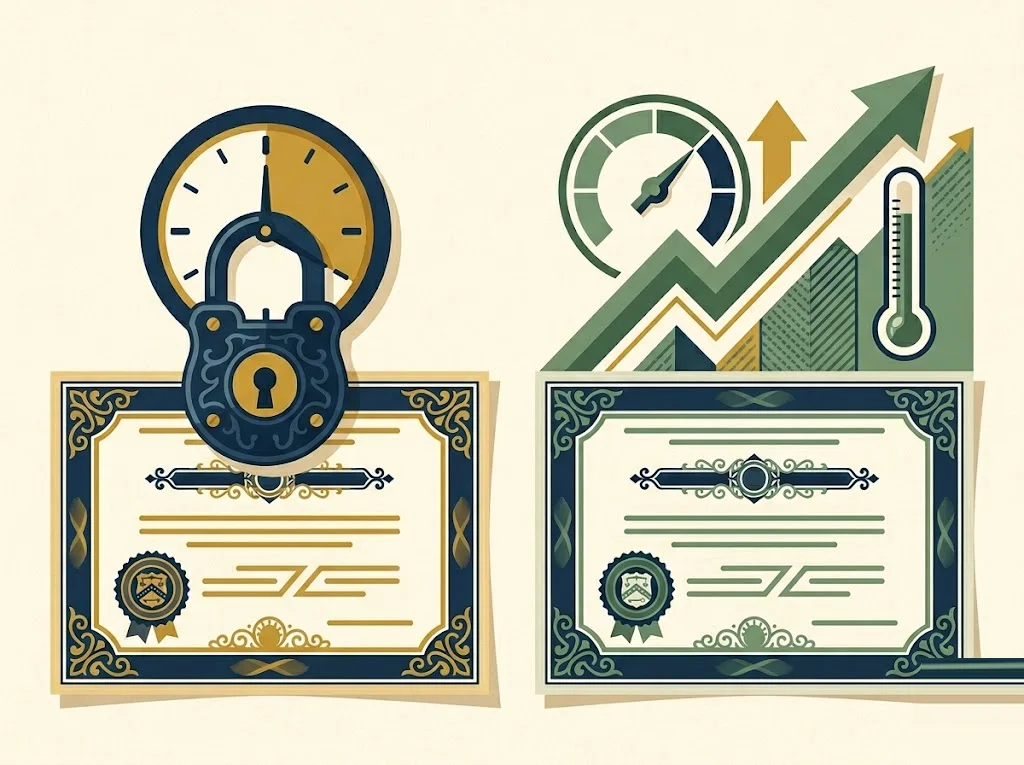
There is a tidy piece of advice that circulates every time inflation makes the news: buy I bonds, they’re the government’s inflation-proof savings account. It isn’t wrong, exactly. But it quietly assumes the only US savings bond worth owning is the Series I, and it skips over the fact that the Treasury sells a second bond — the Series EE — that makes a completely different promise. The two are not better-and-worse versions of the same product. They insure against opposite risks: one protects the number you’ll have, the other protects what that number can buy. Choosing between them is less a question of which rate is higher than of which fear you’re trying to retire.
This is the head-to-head, just these two bonds. (If you want the full anatomy of the inflation-linked bond on its own, the deep dive on how I bonds work covers the rate mechanics and redemption traps in detail; and whichever you choose, you’ll buy it the same way, through the step-by-step guide to purchasing on TreasuryDirect.) Here the job is narrower: what each bond actually guarantees, where their identical rules end and their personalities diverge, and which one fits the job you have in mind.
Series EE and Series I bonds guarantee fundamentally different things. A Series EE bond issued in 2026 pays a fixed 2.40%, but the Treasury guarantees it will double in value at exactly 20 years — roughly a 3.53% locked annual return — if you hold it the whole time. A Series I bond issued in 2026 pays a 4.26% composite rate that resets every six months with inflation, so it protects purchasing power but carries no doubling promise. Choose EE for a guaranteed nominal payout two decades out; choose I to keep pace with inflation while staying liquid.
What each bond actually guarantees
Start with the EE bond, because its headline rate is misleading on purpose. A Series EE bond issued between May and October 2026 earns a fixed 2.40% annually, and at 2.40% your money would not come close to doubling in 20 years. Yet the Treasury guarantees that it will. The mechanism is a one-time true-up: at the 20-year mark, if the accrued interest hasn’t already doubled the bond’s value, the Treasury adds whatever is needed to get it there. A $1,000 EE bond becomes $2,000 at year 20, full stop. Run that backward and the guaranteed doubling is equivalent to about a 3.53% compound annual yield — a number the Treasury never advertises but effectively promises, provided you hold the bond all 20 years.
The I bond guarantees something else entirely. Its 4.26% composite rate for 2026 issues is built from two parts: a fixed rate of 0.90% that stays with the bond for life, and an inflation component running at 1.67% for the current six-month period, which annualizes to roughly 3.34%. Every six months the Treasury recalculates that inflation piece against the Consumer Price Index, so the rate floats up and down with prices. The promise here isn’t a fixed future dollar amount — it’s that your savings won’t quietly lose ground to inflation, because the rate rises when inflation does. What an I bond can’t tell you is exactly what it’ll be worth in 20 years, because nobody knows what inflation will do between now and then.
So the choice crystallizes: the EE bond hands you certainty about the nominal number and silence about purchasing power; the I bond hands you protection for purchasing power and uncertainty about the exact number.
The rules they share
Before the differences, it’s worth seeing how much these two bonds have in common, because the shared rules shape the decision more than people expect. Both are bought through TreasuryDirect, the Treasury’s own platform, with a $25 minimum and penny precision above that. Both cap you at $10,000 per calendar year per Social Security number — and crucially, those limits are separate, so you can hold $10,000 of each in a single year, $20,000 total, without the purchases competing for the same allowance.
Both also come with the same liquidity strings, and they matter. Neither bond can be redeemed at all in its first 12 months — your money is genuinely locked for a year. After that you can cash out anytime, but redeem before the five-year mark and you forfeit the last three months of interest, a small early-withdrawal penalty that makes both bonds a poor fit for money you might need on short notice. This is why the comparison that matters often isn’t EE-versus-I at all but bonds-versus-cash; if you need same-week access, a different tool wins, which is the whole point of weighing a high-yield savings account against Treasury bills or running the three-way comparison of T-bills, high-yield savings, and money market funds.
The tax treatment is identical too, and it’s genuinely good. Interest on both bonds is fully exempt from state and local income tax — a real edge if you live somewhere like California or New York — and federal tax is deferred until you redeem the bond or it stops earning at 30 years, so the interest compounds untaxed the entire time. Cash either bond for qualified higher-education costs while your modified adjusted gross income sits under the annual phase-out, and you may be able to skip federal tax on the interest altogether. None of these perks favors one bond over the other; they’re features of the savings-bond wrapper itself.
When the EE bond is the right call
The EE bond earns its place in exactly one scenario: you have a known expense roughly two decades away and you want a guaranteed dollar amount waiting for it. A newborn’s college fund, a target you want to hit at retirement, a “in 20 years I want this to be worth double” goal — that is the EE bond’s natural habitat. Because the doubling is contractual and indifferent to interest rates, you can plan around it with a precision no inflation-linked product offers. If you put in $10,000 today, you know with certainty that you’ll have $20,000 in 2046.
The catch is the all-or-nothing structure of that guarantee. The doubling lives entirely at the 20-year line. Hold the bond 19 years and 11 months and you’ve earned only the unremarkable 2.40% the whole way, with no doubling to show for it — you’d have walked away just before the one feature that justified buying it. The EE bond therefore rewards patience absolutely and punishes impatience completely. If there’s a real chance you’ll need the funds sooner, its central promise simply doesn’t apply to you, and you’re better off elsewhere.
When the I bond wins
For nearly everyone whose horizon is shorter than 20 years, or whose chief worry is that inflation will erode their savings, the I bond is the better instrument. Its 4.26% composite rate for 2026 issues already beats the EE bond’s 2.40% accrual handily, and unlike the EE bond it doesn’t need to be held two decades to be worth owning — the rate works for you from the start, subject only to the shared 12-month lockup and the five-year penalty window. That makes the I bond a far more flexible store of medium-term savings: an emergency-fund supplement past the first year, a parking spot for cash you don’t want eaten by rising prices, a five-year goal.
The I bond’s variable rate cuts both ways, and honesty requires naming it. When inflation cools, the inflation component shrinks, and your I bond rate falls with it — there have been stretches where the inflation piece dropped to near zero and the bond rode on its small fixed rate alone. You are buying protection, not a guaranteed high yield, and the price of that protection is a rate you can’t pin down in advance. But protection against the unknown is precisely what most savers actually need, and it’s what the I bond delivers and the EE bond cannot.
A reasonable approach, if you have the appetite and the cash, is to stop treating this as either-or. The two bonds genuinely do different jobs, and because their $10,000 annual limits are independent, you can run a barbell: I bonds for inflation-protected, medium-term liquidity, and EE bonds for a guaranteed nominal sum two decades out. For most people, though, the practical answer is simpler. Unless you have a firm 20-year hold and crave certainty about the exact dollar figure, start with the I bond — it’s the more forgiving choice for the more common situation. Whichever you land on, confirm the current numbers yourself, since they reset twice a year. The glossary entry on TreasuryDirect explains the platform you’ll use, and the entry on APY clarifies why a bond’s stated rate and its true compounded yield aren’t always the same figure.
Sources
- TreasuryDirect — Comparing EE and I bonds — side-by-side rules: 2.40% EE rate and 4.26% I rate for May–October 2026 issues, $25 minimum, $10,000 annual limit per series, 12-month redemption lock, three-month interest penalty before five years, federal tax deferral with state and local exemption, and the education exclusion.
- TreasuryDirect — EE bonds — the 2.40% fixed rate for May–October 2026 issues and the Treasury guarantee that the bond doubles in value at exactly 20 years, with a one-time adjustment if accrued interest hasn’t already doubled it.
- TreasuryDirect — I bonds interest rates — the 4.26% composite rate for May–October 2026 issues, decomposed into a 0.90% fixed rate and a 1.67% semiannual inflation rate (about 3.34% annualized), with the inflation component resetting every six months.
- TreasuryDirect — I bonds — how the composite rate combines a fixed rate held for the life of the bond with a CPI-based inflation rate recalculated semiannually.
The ~3.53% figure attributed to the EE doubling guarantee is the compound annual yield implied by a value that exactly doubles over 20 years; the realized return depends on holding the bond the full term, since the doubling adjustment is applied only at year 20.
Quick answers
Are Series I or Series EE bonds a better investment right now?
It depends on which risk you want to insure against, not on which rate is higher today. For bonds issued May through October 2026, the Series I bond pays a 4.26% composite rate while the Series EE bond pays a 2.40% fixed rate — so I bonds look like the obvious winner at first. But the EE bond carries a separate promise: the Treasury guarantees it doubles in value at exactly 20 years, which works out to roughly 3.53% compounded annually and is locked in regardless of where rates go. The I bond rate, by contrast, resets every six months with inflation. If you want a known nominal payout in 20 years, EE wins; if you want your purchasing power protected along the way, I wins.
Why does the Series EE bond double in value at 20 years?
Because the Treasury guarantees it will. The stated fixed rate on a Series EE bond issued in 2026 is only 2.40%, which on its own would not double your money in 20 years. So at the 20-year mark the Treasury makes a one-time adjustment: it adds whatever value is needed to bring the bond to exactly twice its purchase price. A $1,000 EE bond is worth $2,000 at year 20. That guaranteed doubling is equivalent to about a 3.53% annual return — but it only materializes if you hold the bond the full 20 years. Cash out at year 19 and you get only the modest 2.40% accrual with no doubling.
Can I buy both Series I and Series EE bonds in the same year?
Yes, and the purchase limits are separate. Through TreasuryDirect you can buy up to $10,000 in electronic Series I bonds and a separate $10,000 in electronic Series EE bonds each calendar year, per Social Security number — $20,000 in total across both series. The minimum purchase is $25 for either type, down to the penny above that. Both share the same liquidity rules: you cannot redeem either bond within the first 12 months, and if you cash out before five years you forfeit the last three months of interest.
Do you pay taxes on Series I and Series EE bond interest?
You pay federal income tax on the interest, but it is fully exempt from state and local income tax — a meaningful edge in high-tax states. Federal tax is also deferred: you owe nothing until you redeem the bond or it stops earning interest at 30 years, so the interest compounds untaxed in the meantime. There is one more break. If you cash the bonds to pay qualified higher-education expenses and your modified adjusted gross income falls under the annual phase-out limit, some or all of the interest can be excluded from federal tax entirely under the education savings bond program.
Educational content only. finbarrow is an independent editorial publication, not a licensed financial advisor, broker, tax preparer, or attorney. Verify rates and terms with the issuer or relevant regulator. See disclaimers and funding disclosures.