How to Sell a T-Bill Before Maturity on TreasuryDirect
You cannot sell a T-bill inside TreasuryDirect. Here is the FS Form 5511 transfer to a broker, and the 45-day rule that traps short bills.
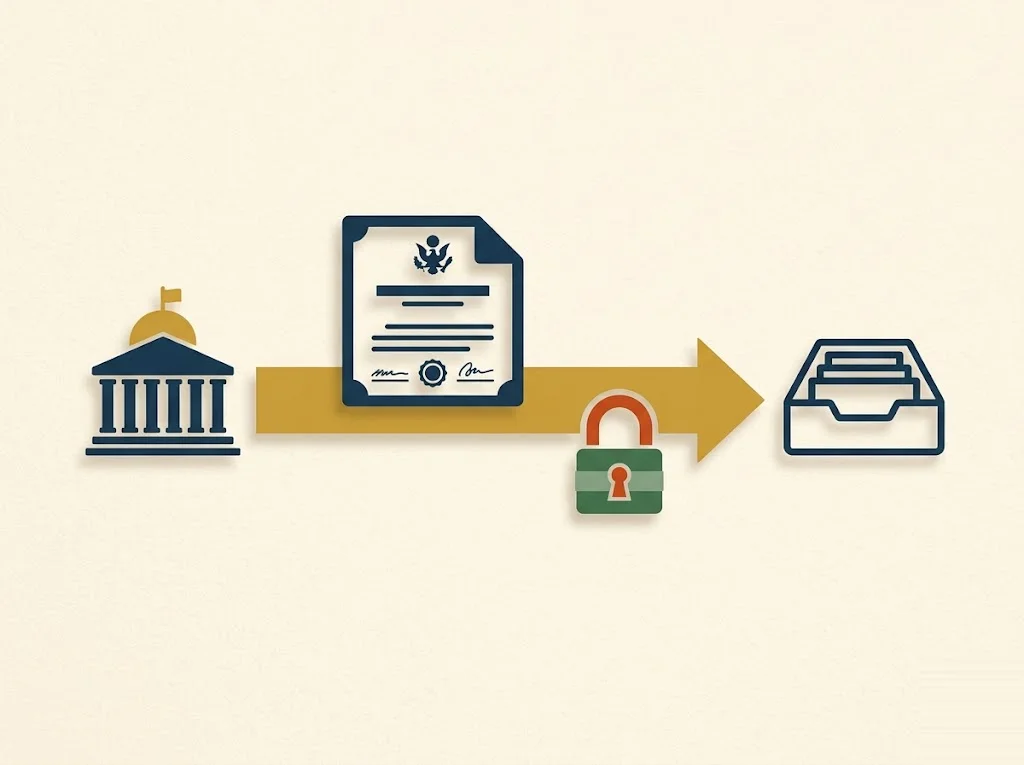
If you bought a Treasury bill on TreasuryDirect expecting that you could sell it the way you sell a stock, the first surprise is what you do not find. You can log in, you can see the security sitting in your account, you can read its maturity date down to the day, and then you go looking for the button that turns it back into cash before that date arrives. There is no such button. TreasuryDirect was built to let ordinary Americans buy government securities straight from the source and hold them, not to run a marketplace where those securities change hands. So the question “how do I sell my T-bill early on TreasuryDirect” has an answer that catches almost everyone off guard, because the honest version is that you do not sell it there at all.
The short answer: TreasuryDirect has no secondary market, so you cannot sell a Treasury bill, note, or bond inside it. To get out before maturity you first transfer the security to a bank, broker, or dealer using FS Form 5511, and then that institution sells it for you on the open market. On top of that, a 45-day hold from the issue date blocks any sale or transfer of a newly bought security, which makes very short bills effectively impossible to sell early.
Why there is no sell button inside TreasuryDirect
The reason comes down to what TreasuryDirect actually is. It is a direct channel between you and the U.S. Treasury, designed for buying securities at auction and holding them until they pay out. It is not a brokerage, and it never tries to be one. A secondary market is the place where investors trade securities with one another after issuance, and that machinery lives in what the Treasury calls the commercial book-entry system, which is the network of banks, brokers, and dealers. TreasuryDirect simply does not connect to it for the purpose of selling.
That design choice has a clear consequence for anyone who needs liquidity earlier than planned. Your only two real exits are to hold the security until it matures, at which point the Treasury pays you automatically, or to move the security out of TreasuryDirect and into a financial institution that can sell it. There is no third option, no early redemption, no calling a desk to unwind the position from inside your TreasuryDirect login. If you genuinely need the money before maturity, the transfer is the path, and it is worth understanding before you commit cash to a bill you might not be able to wait on. For the broader picture of where these securities fit alongside your other cash, see the savings hub.
The FS Form 5511 transfer process, step by step
The instrument that moves a security out of TreasuryDirect is FS Form 5511, the TreasuryDirect Transfer Request. By completing it you authorize the Treasury to remove the securities from your TreasuryDirect control and deliver them to a designated financial institution or brokerage. Marketable securities can be transferred in full or in increments of one hundred dollars, so you do not have to move the entire holding if you only need to free up part of it. One detail to watch: any scheduled reinvestments tied to the security you are transferring are cancelled at the moment of transfer, so a bill you had set to roll over will stop rolling once it leaves — the mechanics of those rolling schedules, and how they differ at a broker, are covered in our guide to how T-bill auto-roll actually works.
If you want the form itself walked through field by field — who can certify it, the $100 increments, where it gets mailed — we keep a separate step-by-step guide to FS Form 5511. The form also carries a requirement that surprises people used to fully digital finance. It must be signed in the presence of an authorized certifying official, the kind you can find at a bank, trust company, or credit union, and then mailed in for processing rather than submitted online. In practice the sequence runs like this. First, confirm that at least forty-five days have passed since the issue date, because the transfer cannot proceed otherwise. Second, open or confirm a brokerage account that accepts incoming Treasury transfers and obtain its routing and delivery instructions. Third, complete FS Form 5511 with the brokerage’s details and the specific securities you want to move. Fourth, have your signature certified at a bank or credit union. Fifth, mail the completed form to the Treasury. Sixth, once the security arrives at the broker, place your sell order there. None of these steps is difficult on its own, but together they take real days, and that timeline is exactly why this route suits planning more than emergencies.
The 45-day rule and the 4-week-bill trap
Layered on top of the transfer process is a holding rule that quietly defeats the most common short bills. The Treasury states it plainly: “When you buy a Treasury marketable security, you must hold it in your TreasuryDirect account for 45 days before selling or transferring it.” The clock starts on the issue date, not on the day you placed the order or the day the auction closed, so you count forty-five days forward from when the security was actually issued to you.
For longer bills, notes, and bonds, this restriction is a brief inconvenience that lifts long before you would realistically want to sell. For the shortest bills it is a wall. The four-week bill is the clearest casualty, and the Treasury spells out the consequence directly: “You can’t sell or transfer a 4-week bill from TreasuryDirect because it matures in less than 45 days.” The bill simply reaches its maturity date and pays out before the transfer restriction ever lifts, so there is no window in which to move it. The same trap closes around any very short bill you might want out of before the forty-five days pass. The practical takeaway is unavoidable: if you buy a four-week bill, or anything close to it, on TreasuryDirect, you are committed to holding it to maturity. Selling early is not a slow option for those bills; it is a non-option.
Where to buy bills you might sell early
All of this points to a single planning lesson that is easy to apply once you have learned it the hard way. Bills you might need to liquidate early do not belong in TreasuryDirect in the first place. They belong in a brokerage account from the start. Inside a broker, a Treasury bill behaves the way most people assume it should: you can sell it on the secondary market on any business day, and the proceeds typically settle in a day or two, with no certified form to mail and no waiting period to clear before you act.
That does not make TreasuryDirect a worse place to buy Treasuries in general. For securities you fully intend to hold to maturity, buying direct is clean and free of the spreads or fees a broker might layer on, and the savings can compound over a ladder of bills. The point is to match the account to your intentions. Money you are certain you can leave untouched can sit happily in TreasuryDirect, where holding to maturity is the whole design. Money that carries even a chance of an early call belongs where selling is a single click rather than a multi-step paper transfer governed by a forty-five-day clock. If you are also weighing the tax side of holding Treasury inflation-protected securities, the mechanics of phantom income on TIPS are worth reading before you commit, because they change how much cash a held-to-maturity strategy actually frees up. Choose the account before you buy, and you will never go hunting for a sell button that was never there.
One last thing the sale itself does not settle: the tax bill. When a T-bill leaves your hands before maturity, part of the gain is treated as ordinary interest under a day-count formula and only the remainder as capital gain — the arithmetic, and how it lands on your 1099-B, is worked through in how an early T-bill sale is taxed.
Sources
- TreasuryDirect, “Selling Treasury Marketable Securities”: https://www.treasurydirect.gov/marketable-securities/selling-marketable-securities/
- TreasuryDirect, “Transferring from one system to another”: https://www.treasurydirect.gov/marketable-securities/transferring-between-systems/
- FS Form 5511, TreasuryDirect Transfer Request
Quick answers
Can I sell a Treasury bill inside TreasuryDirect?
No. TreasuryDirect has no secondary market. To sell before maturity you must transfer the security to a bank, broker, or dealer using FS Form 5511, then sell it there.
What is the 45-day rule on TreasuryDirect?
You must hold any newly bought Treasury marketable security in TreasuryDirect for 45 days before you can sell or transfer it. The clock runs from the issue date.
Why can I not sell a 4-week T-bill from TreasuryDirect?
Because it matures in less than the 45-day hold. A 4-week bill reaches maturity before the transfer restriction lifts, so you simply hold it to maturity.
Where should I buy T-bills I might sell early?
Buy them in a brokerage account. Brokers let you sell on the secondary market on any business day, while TreasuryDirect locks you into holding to maturity unless you transfer out.
Educational content only. finbarrow is an independent editorial publication, not a licensed financial advisor, broker, tax preparer, or attorney. Verify rates and terms with the issuer or relevant regulator. See disclaimers and funding disclosures.