Emergency fund with variable income: size it on your worst months
The 3-6 month rule assumes a paycheck. With variable income, size on essential expenses in your worst months — plus an operating buffer and a tax bucket.
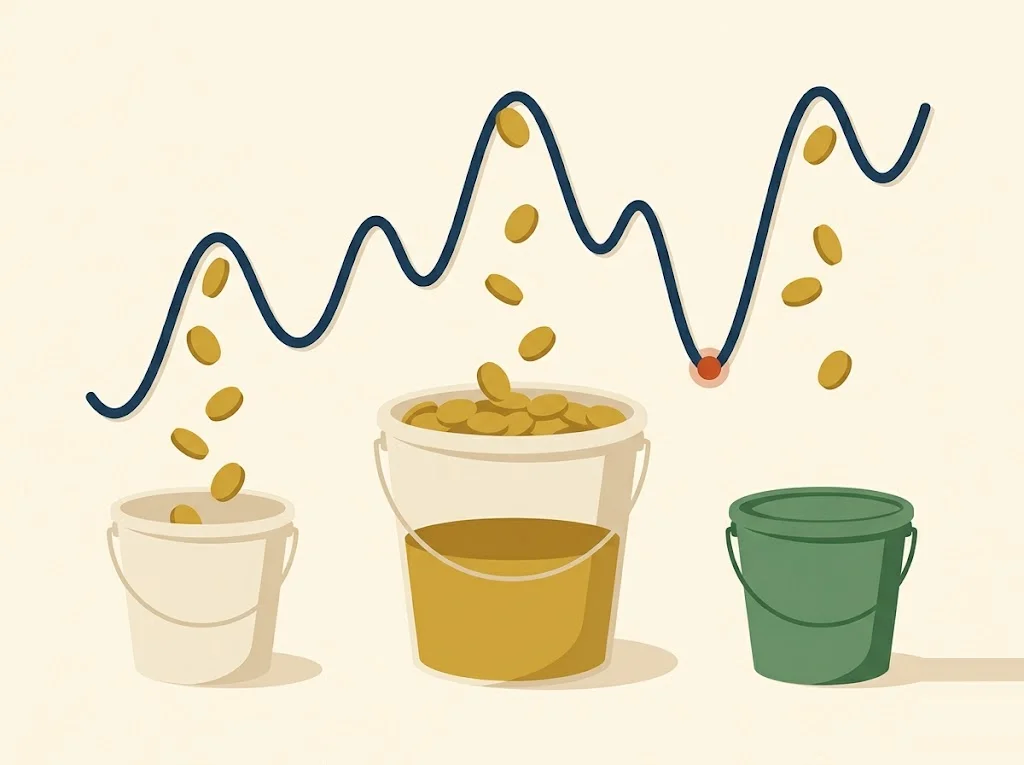
Every emergency fund guide repeats the same line: keep three to six months of expenses in savings. The advice was written for W-2 life, and it quietly assumes the thing it protects — a paycheck that arrives every two weeks no matter what. For freelancers, contractors and anyone paid by the project, income does not pause only in emergencies. It pauses in perfectly ordinary months, too.
That changes the job description. With a salary, the fund handles rare disasters; with variable income it does double duty, covering those same disasters while smoothing the routine valleys between invoices — which arrive far more often than transmissions fail. We have covered how much an emergency fund should hold and what counts as one for the steady-paycheck case. This guide re-runs that math for income that swings, and adds the third account every self-employed person needs.
With variable income, size your emergency fund on essential expenses — housing, insurance, food, debt minimums — and on your worst billing months, never on your average. Target 6 to 12 months of essentials instead of the standard 3 to 6, then split the cash three ways: a one-month operating buffer in checking that absorbs invoice lag, the emergency fund itself in a high-yield savings account or Treasury bills, and a separate tax account that takes a slice of every payment the day it lands. That tax money is not savings — it is already spent.
Why the 3-to-6-month rule assumes a paycheck
Salaried employment performs two invisible services besides paying you: it smooths income, because the deposit is identical every two weeks regardless of how the quarter went, and it plugs you into unemployment insurance if everything ends. Self-employment cancels both at once. Revenue is whatever you billed and collected, and the unemployment system generally does not cover you. The fund has to replace both, which is why the standard sizing runs short.
The baseline being replaced is thin to begin with. In the Federal Reserve’s latest Survey of Household Economics and Decisionmaking — fielded in October 2025 among roughly 13,000 adults and published in May 2026 — 63% of adults said they would cover a surprise $400 expense with cash or its equivalent, unchanged from 2024 and below the 68% peak of 2021, even as 73% described themselves as doing okay or living comfortably. Plenty of households feel fine right up until the month the money skips.
Size it on your worst months, not your average
Adapting the rule takes two substitutions. The first is the yardstick: count essential expenses, not income. The fund exists to keep the non-negotiables paid — rent or mortgage, insurance premiums, utilities, groceries, minimum debt payments — so price one bare-bones month and build on it. Income is precisely the variable you cannot forecast; sizing on it is measuring a flood wall against the average tide.
The second substitution is the reference month. Rank your last twelve months of collections and study the bottom two or three, because those are the months the fund exists for. Then pick a target inside the 6-to-12-month band: more months if your billing concentrates in a few clients, if your pipeline takes a quarter to refill, or if your worst months fall far below your burn; fewer if retainers give you a floor. Six months of essentials is the floor here, not the ceiling.
The three buckets: operating, emergency, taxes
The cash works best split into three accounts with three distinct jobs.
The operating buffer is about one month of essentials in the checking account you pay bills from. Its enemy is timing, not catastrophe: the invoice on net-45 terms, the client who pays two weeks late. Without it, every ordinary lag becomes a raid on the real fund.
The emergency fund proper holds the 6 to 12 months, parked somewhere liquid that still earns. A high-yield savings account, short Treasury bills or a money market fund all qualify, and the yield-versus-liquidity trade-offs among the three come down to tenths of a percentage point; at a bank, a money market account plays the same role. Liquidity outranks yield — this money’s real return is being available on a Tuesday.
The tax bucket is the account W-2 thinking forgets. No employer withholds for you, the IRS expects quarterly estimated payments, and Schedule SE adds 15.3% in self-employment tax on top of income tax. The habit is mechanical: route a fixed percentage of every payment to a separate account the day it lands. No single percentage is correct for everyone — it depends on bracket and state — but the safe-harbor rules set the minimum that keeps you penalty-free.
A worked example: Nora’s $3,200-to-$9,800 year
Nora is a freelance designer. Her last twelve months of collections range from $3,200 to $9,800, with the median near $6,000. The average is a fiction — no actual month looks like it, and it does not pay rent in a $3,200 month. Her essentials — housing, health insurance, food, debt minimums — run $3,900 a month, and that number drives everything.
Bucket one: a $3,900 operating buffer in checking, one month of essentials. In a $3,200 month, collections fall $700 short of the burn; the buffer absorbs the gap without touching the fund, and the next fat month refills it.
Bucket two: eight months of essentials — 8 × $3,900 = $31,200 — in a high-yield savings account or short Treasury bills. Eight sits in the heart of the 6-to-12 band: her billing is lumpy, but steady retainers keep her worst months above zero.
Bucket three: a tax account that receives a fixed slice of every payment on arrival, sized to her bracket and the safe-harbor minimums.
Total safety cash: roughly $35,100. Against the W-2 rule of three to six months that looks enormous, but the comparison is rigged — this pile replaces three systems she does not have: a stable paycheck, unemployment insurance and automatic withholding. In a true zero-revenue stretch, the fund alone covers eight full months of essentials; counting the buffer, nine.
The caveats that actually bite
The most common failure is merging the tax bucket into the fund. Money set aside for quarterly estimates feels like savings because it sits in your account, but it is already spent — it belonged to the IRS the moment the invoice was paid. Count it toward the cushion and the cushion is partly imaginary; the shortfall surfaces in April, the one emergency this system exists to prevent.
The second is sizing on income. Six months of Nora’s median billing suggests $36,000 — close to her actual target, but by luck rather than method. In a drought the question is never how to replace revenue; it is how long the burn stays covered, and only expenses answer that.
The third is chasing yield. Locking the fund into long certificates of deposit, or investing it in stocks, turns insurance into a bet that the emergency will arrive at a convenient time. Keep it liquid, and let each dollar earn whatever its job allows.
What the pile is actually buying
A number like $35,100 reads as overkill until you name what it replaces. Salaried workers get income smoothing, unemployment coverage and tax withholding bundled into the job; the self-employed buy all three with cash. The oversized fund is not anxiety — it is payroll infrastructure for a company of one.
It also scripts the good months. When a $9,800 month lands, the order is fixed: refill the operating buffer, top the emergency fund up to target, fund the tax account in full — and only then does the surplus get invested. Variable income does not forgive skipped steps; it defers the bill to the next bad quarter.
Sources
- Federal Reserve — Economic Well-Being of U.S. Households in 2025 (press release, May 2026) — 63% of adults would cover an unexpected $400 expense with cash or its equivalent, unchanged from 2024 and below the 68% peak of 2021; 73% report doing okay or living comfortably.
- Federal Reserve — Survey of Household Economics and Decisionmaking (SHED) — program page for the survey, fielded in October 2025 among roughly 13,000 adults.
Bucket sizes here are planning frameworks, not individual advice — where you land in the 6-to-12-month band depends on how volatile your billing really is and how fast a lost client can be replaced.
Quick answers
How many months should a freelancer keep in an emergency fund?
Six to twelve months of essential expenses — housing, insurance, food, minimum debt payments — rather than the three to six usually quoted. The standard range assumes a paycheck that keeps arriving while you job-hunt; a freelancer's fund has to cover genuine emergencies and the ordinary valleys between invoices at the same time. Where you land inside that 6-to-12 band depends on how lumpy your billing is and how fast a lost client can be replaced: steady retainers justify the low end, while project-based feast-and-famine work argues for the high end.
Should I base my emergency fund on income or expenses?
Essential expenses, always. The fund exists to keep the non-negotiables paid when money stops arriving, so the relevant number is what survival costs — rent or mortgage, utilities, insurance, groceries, minimum debt payments — not what you bill in a good month. With variable income the case is even stronger, because income is precisely the number you cannot predict, which makes it a useless yardstick. Add up one bare-bones month, multiply by your target number of months, and ignore what the top line did last quarter.
Where should a variable-income emergency fund live?
Split it by job. Keep about one month of essential expenses in the checking account you pay bills from — that is the operating buffer that absorbs late invoices. Park the rest somewhere liquid that still earns: a high-yield savings account, short Treasury bills or a money market fund all work, and the differences among them amount to tenths of a percentage point. Liquidity beats yield here. An emergency fund locked into a long certificate of deposit or invested in stocks is not an emergency fund; it is a bet that the emergency will wait.
Is my tax savings account part of my emergency fund?
No — and merging the two is the fastest way to come up short in April. Money set aside for quarterly estimated taxes is not savings; it was spent the moment you earned it, because no employer is withholding on your behalf. Counting it toward your cushion double-counts the same dollars for two different jobs. Keep a separate account that receives a percentage of every payment the day it lands, sized to your bracket and the safe-harbor rules, and let the emergency fund do only emergency work.
Educational content only. finbarrow is an independent editorial publication, not a licensed financial advisor, broker, tax preparer, or attorney. Verify rates and terms with the issuer or relevant regulator. See disclaimers and funding disclosures.