FHA vs Conventional vs VA — which program fits which household
Side-by-side mechanics: down payment, mortgage insurance, credit score floors, loan limits, and the household profile that makes each program the right pick.
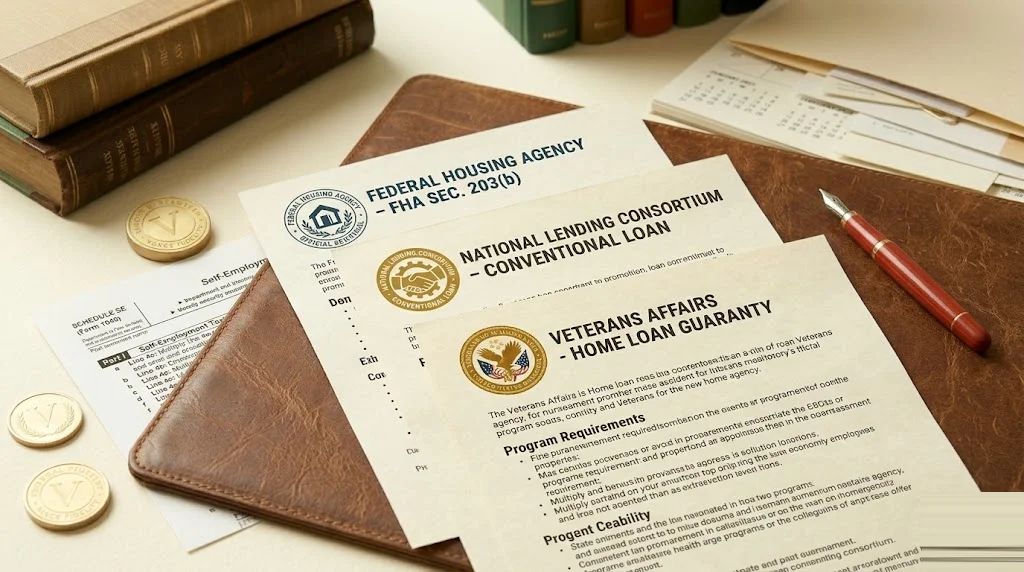
Three federal-backed mortgage programs cover the vast majority of US home purchases for households who do not bring 20% cash down: FHA (Federal Housing Administration), conventional with PMI (typically Fannie Mae or Freddie Mac backed), and VA (Department of Veterans Affairs). They differ structurally in credit requirements, down payment minimums, mortgage insurance treatment, loan limits, and eligibility. For a given household, one of the three is usually meaningfully better than the other two — the choice is not interchangeable, and the wrong choice can cost tens of thousands of dollars over the loan life.
This guide walks through what each program actually is, the side-by-side mechanics that matter for a real purchase decision, three worked examples covering common household profiles, and the specific situations where each program clearly wins.
What each program actually is
FHA loans are mortgages issued by private lenders but insured by the Federal Housing Administration, an agency within the US Department of Housing and Urban Development (HUD). The FHA insurance protects the lender against default, which lets the lender accept lower credit scores and smaller down payments than they would on an uninsured loan. The borrower pays for that insurance via an upfront Mortgage Insurance Premium (UFMIP) of 1.75% of the loan amount (financed into the loan) plus an annual MIP ranging from 0.15% to 0.75% of the outstanding balance depending on loan-to-value and loan amount — 0.55% for the most common case, a base loan under $726,200 with a term over 15 years and less than 10% down — paid as part of each monthly payment. The annual MIP is generally permanent for the life of the loan if the original LTV exceeded 90%.
Conventional loans are mortgages issued by private lenders without federal insurance, typically sold to Fannie Mae or Freddie Mac in the secondary market. Loans under the conforming loan limit follow Fannie/Freddie underwriting guidelines (the “conforming” loans most buyers encounter); loans above the limit are “jumbo” loans with stricter underwriting. Down payments below 20% require Private Mortgage Insurance (PMI), purchased by the borrower from a private insurer (Genworth, MGIC, Radian, others). PMI typically costs 0.3% to 1.5% of the loan amount annually depending on credit score and LTV, and falls off automatically when LTV reaches 78% based on original property value or when the borrower requests removal at 80% LTV based on current appraisal.
VA loans are mortgages issued by private lenders and guaranteed by the Department of Veterans Affairs for eligible veterans, active-duty service members, certain reservists, and qualifying surviving spouses. The guarantee covers a portion of any potential lender loss in default, allowing lenders to offer terms not available on the open market: no down payment requirement, no PMI, and competitive interest rates. VA charges a one-time “funding fee” of 1.25% to 3.3% of the loan amount (varying by down payment size and prior VA loan use), which is financed into the loan and is the only material cost premium for the program. Veterans with certain service-connected disabilities are exempt from the funding fee entirely.
Side-by-side mechanics
| Dimension | FHA | Conventional with PMI | VA |
|---|---|---|---|
| Minimum down payment | 3.5% (FICO ≥580) or 10% (FICO 500-579) | 3% (first-time buyer, FICO ≥620) or 5% standard | 0% |
| Minimum FICO | 580 (3.5% down) / 500 (10% down) | 620 with overlay penalties below 740 | No federal minimum; lender overlays typically 580-620 |
| Mortgage insurance | Upfront 1.75% + annual 0.15–0.75% (0.55% for most 30-year loans under $726,200 with less than 10% down) | PMI 0.3-1.5% annual | None |
| Insurance removal | Permanent for loans with LTV >90% at origination; refinance to conventional to escape | Automatic at 78% LTV; request removal at 80% LTV | N/A |
| Loan limit (2026 baseline) | $541,287 floor (one-unit, most counties; $1,249,125 ceiling in high-cost areas) | $832,750 conforming | Effectively unlimited (lender overlays apply) |
| Funding fee | 1.75% UFMIP rolled into loan | None | 1.25-3.3% funding fee rolled into loan (waived for disabled vets) |
| Occupancy | Owner-occupied only | Owner-occupied, second home, investment | Owner-occupied only |
| Eligibility | Anyone meeting credit + DTI | Anyone meeting credit + DTI | Service member, veteran, surviving spouse |
| Number of loans allowed | Usually 1 FHA at a time | Multiple permitted | Multiple permitted with available entitlement |
Worked example 1: First-time buyer, $80,000 income, $400,000 home
A first-time buyer earning $80,000, with a 690 FICO, $20,000 in savings (5% down on a $400,000 home), no military service.
FHA option:
- Loan amount: $385,250 (after 3.5% down) + $6,742 UFMIP financed = $391,992
- Estimated rate (2026 avg, FICO 690): 6.85%
- Monthly principal + interest: $2,569
- Annual MIP (0.55% × $391,992): $180/month
- Estimated property tax + homeowners insurance: $750/month
- Total monthly: ~$3,499
Conventional 5%-down option:
- Loan amount: $380,000
- Estimated rate (FICO 690 with LLPA penalty): 7.25% (the LLPA matrix penalizes 690 FICO at 95% LTV)
- Monthly principal + interest: $2,592
- PMI (0.75% × $380,000 / 12): $238/month
- Property tax + insurance: $750/month
- Total monthly: ~$3,580
For a 690 FICO at 95% LTV, FHA starts about $81/month cheaper than conventional ($3,499 vs. $3,580), because the 0.55% annual MIP more than offsets FHA’s slightly higher rate. But the MIP is permanent for the life of the loan at this LTV, while conventional PMI drops off entirely at 78% LTV (around year 9-10 of the loan based on amortization). Over a long enough hold, that permanent-vs-temporary difference can still tilt the lifetime cost back toward conventional, even though FHA wins the early monthly comparison.
For this borrower: conventional wins, primarily because of the eventual PMI dropoff.
Worked example 2: First-time buyer, $55,000 income, 615 FICO, $300,000 home
A first-time buyer earning $55,000, with a 615 FICO (recent thin file recovery), $12,500 in savings (4.2% of $300,000), no military service.
FHA option:
- Loan amount: $289,500 (after 3.5% down) + $5,066 UFMIP = $294,566
- Estimated rate (FICO 615, FHA): 7.10% (FHA accepts lower scores without aggressive penalty)
- Monthly principal + interest: $1,981
- Annual MIP (0.55% × $294,566): $135/month
- Property tax + insurance: $600/month
- Total monthly: ~$2,716
Conventional option:
- Loan amount: $285,000 (5% down requires another $2,500 saved)
- Estimated rate (FICO 615 with LLPA): 8.25%+ (conventional LLPA matrix heavily penalizes <660 FICO)
- Monthly principal + interest: $2,141
- PMI (FICO 615 + 95% LTV typically priced at 1.45%): $345/month
- Property tax + insurance: $600/month
- Total monthly: ~$3,086
Conventional costs roughly $370/month more for the same house with the same down payment due to the LLPA rate penalty for sub-660 FICO. FHA saves approximately $4,400/year for this borrower. The permanent MIP only becomes worse-than-conventional after 9-10 years when the conventional PMI drops off; before that, FHA is materially cheaper.
For this borrower: FHA clearly wins. The borrower can plan to refinance to conventional once FICO improves past 700 in 2-3 years.
Worked example 3: Veteran with $400,000 home purchase
A 5-year US Navy veteran earning $90,000, with a 720 FICO, $15,000 in savings, full VA entitlement.
VA option:
- Loan amount: $400,000 (0% down)
- Funding fee (first VA loan, no down payment): 2.15% = $8,600 financed
- Total financed: $408,600
- Estimated rate (FICO 720, VA): 6.65% (VA rates are typically the lowest of the three programs)
- Monthly principal + interest: $2,624
- No PMI, no annual MIP
- Property tax + insurance: $750/month
- Total monthly: ~$3,374
Conventional 5%-down comparison:
- Down payment: $20,000 (would require saving another $5,000)
- Loan amount: $380,000
- Estimated rate (FICO 720, 95% LTV): 7.10%
- Monthly principal + insurance: $2,557
- PMI: ~$190/month
- Property tax + insurance: $750/month
- Total monthly: ~$3,497
For this veteran: VA wins by $123/month AND requires $5,000 less in down payment. Over 30 years, the VA loan saves roughly $45,000 in cumulative interest + insurance versus conventional, while preserving liquidity at closing. The funding fee adds $8,600 to the loan but is more than offset by no PMI and lower rate.
For an eligible veteran with even modest savings, the VA loan is almost always the right choice. There is no scenario where FHA or conventional beats it materially when the buyer is eligible.
When each program clearly wins
FHA is the right choice when:
- FICO is between 580 and 660 and any other path requires waiting to build credit
- Down payment savings are limited (3.5% down acceptable vs the 5% conventional minimum)
- Future plans include refinancing to conventional within 5-7 years (escaping permanent MIP)
- Property purchase price is below the FHA loan limit for the county
- The borrower is unable to qualify for conventional due to debt-to-income ratio (FHA accepts higher DTI than conventional)
Conventional is the right choice when:
- FICO is 680+ (the LLPA matrix becomes friendly)
- Down payment is 10% or more
- The borrower plans to stay in the home long enough for PMI to drop off (~8-10 years at typical amortization)
- The property is a second home or investment property (FHA and VA both require owner-occupancy)
- The borrower wants to avoid permanent mortgage insurance regardless of FICO
VA is the right choice when:
- The borrower is eligible (active duty, veteran, qualifying reservist, qualifying surviving spouse)
- Any down payment is available (technically zero is allowed)
- The borrower wants the lowest available monthly payment
- The borrower wants to preserve cash for home repairs, furnishings, emergency fund
The only scenario where an eligible veteran might choose otherwise: if they want to keep their VA entitlement for a future purchase (the VA loan benefit can be reused, but only after the prior loan is paid off or assumed by another eligible veteran). For first-time buyers with no plans for serial home purchases, this is not a meaningful constraint.
State-level and lender-overlay considerations
The federal program mechanics above apply uniformly across all 50 states. Where states and individual lenders add variation:
- Lender overlays on FICO: many lenders refuse to accept the federal FICO minimums and impose their own (e.g., 620 minimum on FHA even though HUD allows 580 with 3.5% down). Shop multiple lenders for the same program before assuming the FICO floor.
- State-specific first-time homebuyer programs can layer on top of FHA or conventional loans, sometimes providing down payment assistance grants or below-market second mortgages. California’s CalHFA, New York’s SONYMA, Texas’s TSAHC all have specific overlay programs. The combinations can be valuable; check state housing finance agency websites.
- VA county loan limit overlays: most lenders cap VA loans at the conforming loan limit for the county even though the VA itself has no statutory limit since 2020. Higher loan amounts require either a down payment on the excess or shopping for a VA-specialty lender willing to extend the limit.
- MIP/PMI premium variation by insurer: PMI rates differ by provider, so shop quotes across at least two insurers before locking in a conventional loan.
What this guide does not cover
This guide focused on the three primary owner-occupied federal-backed mortgage programs for purchase money loans. It does not cover:
- USDA Rural Development loans — a smaller fourth program for rural properties (defined by USDA-published maps) with 0% down requirement and household income caps. Worth considering for buyers in eligible rural areas; warrants its own analysis.
- Jumbo loans — conventional loans above the conforming limit, with stricter credit and down payment requirements than mainline conventional. Important for high-cost metros like SF, NYC, Boston, Seattle.
- HELOC and home equity loans for existing homeowners — these are secondary mortgages or lines of credit secured by home equity, not purchase money loans.
- State-specific programs in detail — touched on briefly; deserves a state-by-state guide.
- Refinancing between programs — refinancing an FHA loan to conventional (to escape MIP) has specific mechanics worth its own piece. The VA Interest Rate Reduction Refinance Loan (IRRRL) for existing VA borrowers similarly warrants separate analysis.
For the mainline new-purchase decision among FHA, conventional, and VA, the framework above is complete.
What to verify before applying
Always pull current-year program specifics from these sources:
- FHA loan limits and program rules: hud.gov/program_offices/housing/sfh
- FHA annual MIP schedule: HUD Mortgagee Letter 2023-05 (case numbers assigned on or after March 20, 2023)
- Conventional conforming loan limits: fhfa.gov/data/conforming-loan-limits
- VA home loan eligibility and program: va.gov/housing-assistance/home-loans/
- Fannie Mae LLPA matrix: singlefamily.fanniemae.com/media/9391/display (the credit-score-based rate adjustment table)
- HUD FHA Loan Performance Trends: hud.gov/program_offices/housing/comp/rpts/fhalpt
The structural comparison in this guide does not change year to year. What changes: the conforming/FHA loan limits (updated each November for the following year), specific PMI/MIP rates, VA funding fee schedule, and the LLPA matrix. Verify the current numbers before locking your specific rate quote.
Quick answers
Can a borrower with a 650 FICO realistically get a conventional mortgage?
Yes, but with rate and PMI penalties. Conventional loans backed by Fannie Mae or Freddie Mac typically accept FICO scores from 620 upward, but the interest rate adjustment for credit (the "loan-level price adjustment" or LLPA matrix Fannie publishes) penalizes scores below 740 progressively. At 650 FICO, a conventional borrower might pay 0.5 to 1.0 percentage points more in rate than a 760 FICO borrower for the same loan-to-value, plus private mortgage insurance (PMI) at 0.5%–1.5% annually until 78% LTV is reached. An FHA loan at the same 650 FICO can sometimes produce a lower monthly payment despite the upfront MIP because FHA insurance premiums and rates do not penalize sub-740 scores as aggressively.
Is a VA loan available to surviving spouses of veterans?
Yes, in specific cases. Unremarried surviving spouses of veterans who died on active duty or from a service-connected disability are eligible for the VA loan benefit under the same terms as the veteran would have been. Surviving spouses whose veteran died of a non-service-connected cause after eligibility was established are also eligible in many cases. The VA publishes an eligibility flow at benefits.va.gov; the application is via Form 26-1817 (Request for Determination of Loan Guaranty Eligibility — Unmarried Surviving Spouses). The benefits — no down payment, no PMI, no max purchase price beyond the lender overlay — are identical.
Does the FHA loan limit work the same way as conventional conforming limits?
Yes for the conforming side, with adjustments. Each year HUD publishes FHA loan limits by county, calibrated as a percentage of the Federal Housing Finance Agency conforming loan limit for that county. In most US counties the FHA limit is 65% of the conforming limit. In "high-cost" counties (parts of California, the DC metro, Hawaii, Alaska, New York metro) the FHA limit caps at 150% of the standard conforming limit. The conventional conforming limit for 2026 (and the derived FHA limit) is published each November at fhfa.gov/data/conforming-loan-limits. VA loans technically have no maximum loan amount since the 2020 Blue Water Navy Vietnam Veterans Act, but lenders still apply overlay limits — most stop at the conforming limit unless the borrower has unused entitlement and accepts a down payment on the excess.
Can I have both an FHA loan on my current home and a conventional loan on a second home?
Generally no. FHA loans require that the property be occupied as the borrower's primary residence within 60 days of closing and for at least one year afterward. Holding an FHA loan disqualifies the borrower from holding another FHA loan in most situations (there are narrow hardship exceptions for relocation, family size growth, divorce). Conventional loans permit second homes and investment properties as a routine matter, with different (typically higher) down payment and rate requirements. So the standard path is: use FHA for the first home if appropriate, then refinance to conventional later if a second-home or investment-property purchase is planned, freeing the FHA entitlement.
Educational content only. finbarrow is an independent editorial publication, not a licensed financial advisor, broker, tax preparer, or attorney. Verify rates and terms with the issuer or relevant regulator. See disclaimers and funding disclosures.