VTSAX vs VTI: same fund, two wrappers — which to buy?
VTSAX and VTI hold the identical index, so returns match. The real choice is plumbing: minimums, fractional shares, and how you buy.
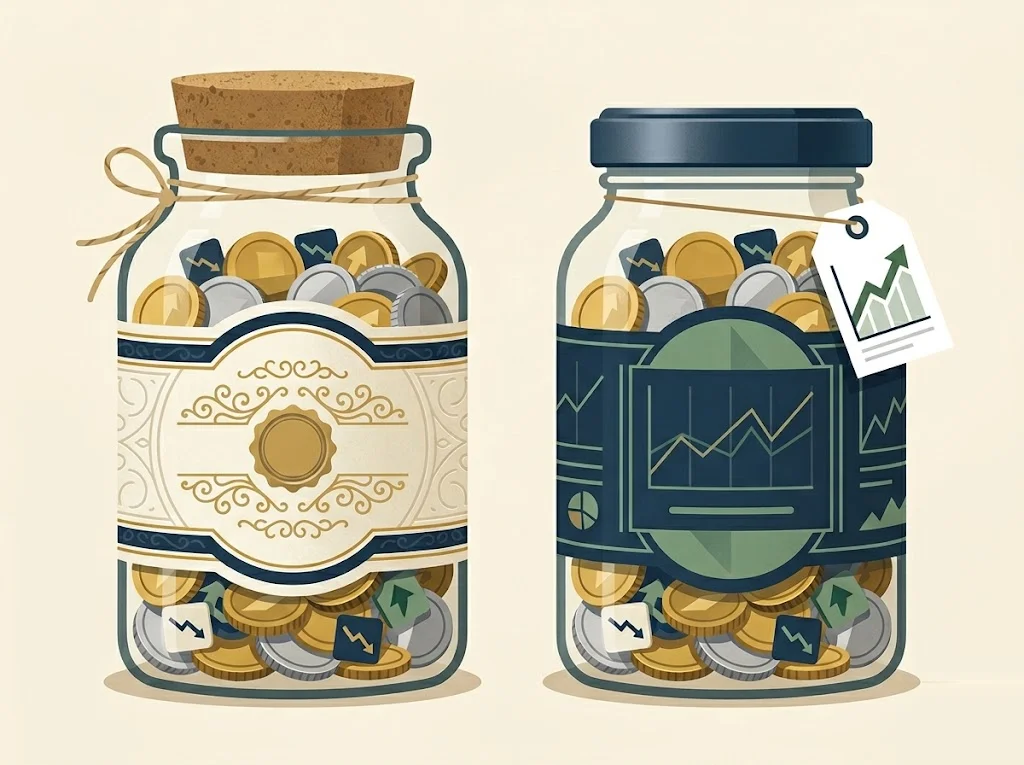
Search “VTSAX vs VTI” and you will find thousands of words arguing over which Vanguard fund wins, as if one quietly outperforms the other. That framing is wrong from the start. VTSAX and VTI are not rivals tracking similar markets — they are the same fund, holding the same stocks, following the same index, run by the same managers. Vanguard simply sells that single portfolio in two formats: one is a traditional mutual fund, the other is an exchange-traded fund, a basket of stocks that trades on an exchange like a single stock does. The returns are, by design, identical. So the real decision has nothing to do with performance. It is a question of plumbing — minimums, how you place the order, whether you can buy a fraction, and how the fund behaves when you are nervous and watching the price.
This is the ticker-specific comparison, narrower than the general index-fund-versus-ETF breakdown that weighs the two structures across the whole market, and narrower than the tax-efficiency deep dive on ETFs versus index funds. Here the job is to put two particular wrappers side by side and tell you which one fits how you actually invest.
VTSAX and VTI hold the identical portfolio — the CRSP US Total Market Index, roughly 3,500 to 4,000 US stocks — so their gross returns are the same. The choice is mechanical, not about performance. VTI is an ETF: it costs 0.03%, has no minimum beyond one share (or a fraction at many brokers), trades intraday, and moves to any brokerage. VTSAX is a mutual fund: it costs 0.04%, needs $3,000 to start, prices once a day, and lets you invest an exact dollar amount and automate it.
They are literally the same fund
This is the fact that should reframe the whole question. Both VTSAX and VTI seek to track the CRSP US Total Market Index, which Vanguard describes as covering close to 100% of the investable US stock market — large-, mid-, small-, and micro-cap companies traded on the New York Stock Exchange and Nasdaq, somewhere in the range of 3,500 to 4,000 holdings. It is not two managers buying two similar baskets. Under Vanguard’s structure, VTI is a share class of the very same fund whose Admiral share class is VTSAX. Same portfolio, same holdings, same management. The fund has other share classes too: VITSX, the Institutional Shares version with an institutional-scale minimum, is the one large retirement plans buy — if it appears in your 401(k) menu, that is this same portfolio again under a third ticker, not a different fund to evaluate.
The practical consequence is that any debate about which fund “returns more” is essentially a rounding error. Gross of fees, they return the same thing because they own the same thing. The only built-in difference in cost is the expense ratio — what the fund charges annually to run itself — and that gap is 0.01 percentage points: 0.03% for VTI against 0.04% for VTSAX. On a $10,000 position, that is the difference between three dollars and four dollars a year. Worth knowing, not worth losing sleep over, and not a reason on its own to pick one wrapper. For the full definition of how that fee works, see the expense-ratio glossary entry.
One tangent worth clearing up, because the tickers get mixed together in searches: VTIAX is not another share class of this fund. It is Vanguard’s Total International Stock Index Fund — the ex-US counterpart — and its ETF share class is VXUS. Pairing VTSAX (or VTI) with VTIAX (or VXUS) is how a two-fund global stock portfolio is usually built; comparing VTSAX against VTIAX is comparing US against international, not fund against wrapper. Two more tickers that drift into the same searches: VOO is Vanguard’s S&P 500 ETF — roughly 500 large-cap companies, not the total market — and VT is the Total World fund, US plus international in a single holding. Neither is a share class of VTSAX; both are different portfolios answering different allocation questions.
So if returns and cost are effectively a tie, what is left to decide? Everything about how you buy and hold the thing.
How you buy: dollars versus shares
This is the difference that actually changes your day-to-day investing, and it splits cleanly.
VTSAX, as a mutual fund, is bought and sold in dollars at the fund’s net asset value, calculated once after the market closes. You can tell Vanguard to invest exactly $500, and you get $500 worth of fund — every cent put to work, down to fractional units the system handles automatically. That makes VTSAX ideal for the investor who wants to set up an automatic monthly contribution and never think about it again: a fixed dollar amount goes in on schedule, fully invested, no leftover cash. The cost of that convenience is the $3,000 minimum to open a position (Vanguard lowered the Admiral minimum from $10,000 to $3,000 back in November 2018) and the fact that you trade only once a day, at a closing price you do not know at the moment you place the order.
VTI, as an ETF, trades like a stock throughout the day at a live market price. Classically that meant you had to buy whole shares — one share of VTI runs somewhere around $250 to $300 — which made precise dollar investing awkward and left small amounts of cash stranded. That limitation has largely dissolved: many major brokers, Vanguard included, now let you buy fractional shares of ETFs, so you can put in $50 or $500 and own a sliver. Where fractional buying is supported, VTI’s old disadvantage mostly disappears. Where it is not, you are back to buying in whole-share chunks. VTI also has effectively no minimum beyond the price of the slice you want, which makes it the natural starting point for someone with less than $3,000 to commit who cannot yet meet VTSAX’s threshold.
The honest summary: if you live inside a Vanguard account and want true autopilot — a set dollar amount swept in monthly without a thought — VTSAX’s design is built for exactly that. If you want to invest small or irregular amounts, or your broker handles fractional ETF shares well, VTI does the same job with more flexibility.
Portability and behavior under stress
Two quieter differences matter more than the order screen suggests.
The first is portability. VTI, like any ETF, is a standard security you can hold at any brokerage and move between them via an in-kind transfer, without selling. VTSAX is a Vanguard fund; while other brokerages can hold it, you sometimes face transaction fees to buy it outside Vanguard, and moving Vanguard mutual fund shares elsewhere is clunkier than moving an ETF. If there is any chance you will switch brokers down the road — chasing a better platform, consolidating accounts — VTI travels more cleanly. This is the single strongest practical argument for the ETF for a young investor who does not yet know where their accounts will live in ten years.
The second is behavior under stress, and it cuts the other way. Because VTI trades intraday at a visible, twitching price, it invites tinkering. When markets drop, watching VTI tick down in real time tempts some investors to sell, to set limit orders, to time a re-entry — exactly the behavior that wrecks long-term returns. VTSAX prices once, after the close, so there is no intraday number to react to; you place an order and it settles at the day’s NAV regardless. For an investor who knows they are jumpy, that enforced patience is a feature, not a limitation. The “worse” wrapper for a trader is often the better wrapper for a buy-and-hold index investor’s temperament — a theme that runs through how we think about allocating by age and risk tolerance and choosing between a target-date fund and a three-fund portfolio.
The tax angle is smaller than it used to be
You will read that ETFs are dramatically more tax-efficient than mutual funds, and in general that holds — but for this specific pair the gap has nearly closed, for a reason most comparisons miss.
Vanguard long held a patented structure that let it run an ETF share class alongside a mutual fund share class of the same fund, using the ETF’s mechanics to flush out appreciated stock and keep capital gains distributions low across all share classes. That is why VTSAX, unusually for a mutual fund, has gone essentially without a capital gains distribution since around 2000 — the ETF wrapper was quietly protecting the mutual fund holders too. The catch is that Vanguard’s patent on that structure expired in May 2023. Going forward, the long-standing tax parity between VTSAX and VTI rests on Vanguard maintaining the arrangement rather than on an exclusive legal moat, and competitors are now filing to copy it. For a holder today, the takeaway is simple: in a taxable account the two remain close to tax-equivalent, which is unusual and favorable, but it is not a permanent law of nature.
And if you are choosing inside a Roth IRA or a 401(k), all of this tax talk is moot. Capital gains distributions are not taxed inside a tax-advantaged account, so the ETF structure’s edge is worth exactly zero there. Choose purely on mechanics: dollar-based automation (VTSAX) versus fractional flexibility and portability (VTI). This is also why “VTI or VTSAX for a Roth IRA” has the least consequential answer of any version of this question — in that account, they are genuinely interchangeable.
One mechanism does still belong to VTI. Vanguard lets you convert VTSAX into VTI without it counting as a sale — because they are two share classes of one fund, the conversion triggers no capital gain. That can be handy if you start in the mutual fund and later want the ETF’s portability. But the conversion runs one way only: you cannot convert VTI back to VTSAX. Reversing means selling the ETF and rebuying the fund, a taxable event in a regular account. Treat the move from VTSAX to VTI as a door that locks behind you.
How to convert VTSAX to VTI, step by step
The conversion is the piece people search for most, so here is the whole mechanic in one place.
- It happens at Vanguard, and only at Vanguard. VTSAX and VTI are two share classes of one fund, and the share-class conversion is something only the fund’s own custodian can execute. If you hold VTSAX at another brokerage, you would either transfer the position to Vanguard first or sell it (a taxable event in a regular account).
- Request the conversion. At Vanguard the conversion is requested from the holding’s transact options, or by phone if your account does not show the online path. You are not placing a sell order — you are asking Vanguard to exchange mutual fund shares for the equivalent ETF shares of the same fund.
- It executes at that day’s closing NAV, with no sale. No capital gain is realized, nothing is reported as a sale, and both your cost basis and your holding period carry over to the VTI shares. This is the feature that makes the move free in a taxable account, where selling and rebuying would trigger gains.
- It is one-way. Vanguard converts VTSAX into VTI but will not convert VTI back into VTSAX. Undoing the move means selling the ETF and buying the mutual fund again — taxable. Treat the conversion as a door that locks behind you.
- After converting, the position is portable. VTI is a standard ETF that can move to any brokerage via an in-kind transfer — which is the most common reason people convert in the first place.
The conversion makes sense for a VTSAX holder who wants the ETF’s portability or the marginally lower fee without a tax bill. It makes no sense as a performance move, because there is no performance difference to capture.
So which one should you buy?
Stop optimizing for performance, because there is nothing to optimize — the returns are the same fund. Decide on plumbing instead.
Choose VTSAX if you already hold money at Vanguard, can meet the $3,000 minimum, and want to automate a fixed dollar amount every month and never look at it. Its once-a-day pricing and dollar-based buying are purpose-built for hands-off, autopilot investing, and the slightly higher 0.04% fee is a rounding error against that convenience.
Choose VTI if you are starting with less than $3,000, want to invest small or fractional amounts, value the freedom to move the holding to any brokerage later, or simply want the 0.01% lower fee and intraday flexibility. For a younger investor whose financial life is still taking shape, VTI’s portability is usually the deciding factor.
And if you cannot decide, it genuinely does not matter much — you would be buying the identical portfolio either way, and you can convert VTSAX into VTI tax-free at Vanguard later if your needs change. Just remember that door only swings one direction.
Sources
- Vanguard — Total Stock Market Index Fund Admiral Shares (VTSAX) profile — CRSP US Total Market Index, 0.04% expense ratio, Admiral share class.
- Vanguard — Total Stock Market ETF (VTI) profile — CRSP US Total Market Index, 0.03% expense ratio, ETF share class.
- SEC EDGAR — Vanguard Index Funds, Form 497K prospectus (Total Stock Market Index Fund) — index tracks approximately 100% of the investable US stock market across large-, mid-, small-, and micro-cap stocks.
- Vanguard — Cuts minimum investment to $3,000 for Admiral Shares (November 2018, via The Seattle Times) — Admiral minimum lowered from $10,000 to $3,000.
- CNBC — Vanguard’s expired patent may emerge as game changer for the fund industry — share-class structure, capital gains suppression, and the May 2023 patent expiration.
- Bogleheads — Tax-free conversion of Vanguard mutual fund to ETF — VTSAX-to-VTI conversion is not a taxable event; the conversion is one-way and irreversible, and reversing it requires a taxable sale.
Expense ratios, the $3,000 Admiral minimum, and the index methodology are Vanguard’s published figures as of 2026; the approximate VTI share-price range reflects recent market prices and moves daily. The tax parity between the two funds depends on Vanguard maintaining its share-class structure following the 2023 patent expiration.
Quick answers
Is VTSAX or VTI better?
Neither is "better" on returns — they hold the identical portfolio (the CRSP US Total Market Index), so their gross performance is the same. The decision is mechanical. VTSAX, a mutual fund, lets you invest an exact dollar amount and automate contributions, but needs a $3,000 minimum and trades once daily at the closing price. VTI, an ETF, has no minimum beyond one share (or a fraction at many brokers), trades intraday, moves to any brokerage, and charges 0.01% less. If you hold at Vanguard and want hands-off dollar automation, VTSAX fits; if you want portability and fractional flexibility, VTI fits.
What is the expense ratio difference between VTSAX and VTI?
VTI charges 0.03% a year and VTSAX charges 0.04%, a gap of 0.01 percentage points. On a $10,000 balance that is one dollar a year — three dollars versus four. The difference is real but trivial, and it almost never justifies choosing one fund over the other by itself. Vanguard prices the ETF share class slightly lower largely because ETFs cost less to administer; the recordkeeping behind a mutual fund account is more expensive to run. For a long-term holder, the one-basis-point edge is a tiebreaker, not a deciding factor.
Can I convert VTSAX to VTI without paying taxes?
Yes, if both are held at Vanguard. Because VTSAX and VTI are two share classes of the same underlying fund, Vanguard can convert your mutual fund shares into ETF shares without it counting as a sale, so no capital gains are triggered. But the conversion runs one way only: you cannot convert VTI back into VTSAX. Reversing course means actually selling the ETF and rebuying the mutual fund, which is a taxable event in a regular brokerage account. Treat the move from VTSAX to VTI as permanent before you make it.
Do VTSAX and VTI pay the same dividends and have the same returns?
Effectively yes. They track the same index and hold the same stocks, so they pay essentially the same dividends and post the same total return before the tiny expense difference. You may see returns quoted a hair apart on any given day because the ETF trades intraday at a market price while the mutual fund prices once at the close, but over months and years the two converge. Historically VTSAX also avoided capital gains distributions thanks to Vanguard's share-class structure, leaving little tax gap between the two.
Can you buy VTSAX on Robinhood?
No. Robinhood does not offer traditional mutual funds, and VTSAX is a mutual fund, so it cannot be bought or held there. The Robinhood-compatible version of the same portfolio is VTI, the ETF share class, which trades like a stock and supports fractional shares on the platform. If you already hold VTSAX at Vanguard and want to move to Robinhood, convert VTSAX to VTI at Vanguard first — a non-taxable share-class conversion — and then transfer the VTI shares in kind.
What is the minimum investment for VTSAX?
$3,000 for the initial purchase — the minimum Vanguard has set for Admiral-class index funds since November 2018, when it was lowered from $10,000. After the initial investment, subsequent contributions can be any dollar amount. VTI has no minimum beyond the price of one share, and less than that at brokers offering fractional ETF shares, which is why investors starting with less than $3,000 usually begin with VTI.
Is VTSAX a mutual fund or an ETF — and what is the ETF equivalent?
VTSAX is a mutual fund — specifically the Admiral share class of the Vanguard Total Stock Market Index Fund. It is not an ETF. The ETF equivalent is VTI: the exchange-traded share class of the exact same fund, holding the same stocks and tracking the same CRSP US Total Market Index. Because they are share classes of one fund, "the ETF version of VTSAX" is not an approximation — VTI literally is the same portfolio in an exchange-traded wrapper. The fund also has an institutional share class, VITSX, which is what large retirement plans buy.
Educational content only. finbarrow is an independent editorial publication, not a licensed financial advisor, broker, tax preparer, or attorney. Verify rates and terms with the issuer or relevant regulator. See disclaimers and funding disclosures.