401(k) rollover: direct vs indirect and the 20% trap
A direct 401(k) rollover moves the full balance untaxed. An indirect one withholds 20% and starts a 60-day clock — replace the 20% yourself or it is taxed.
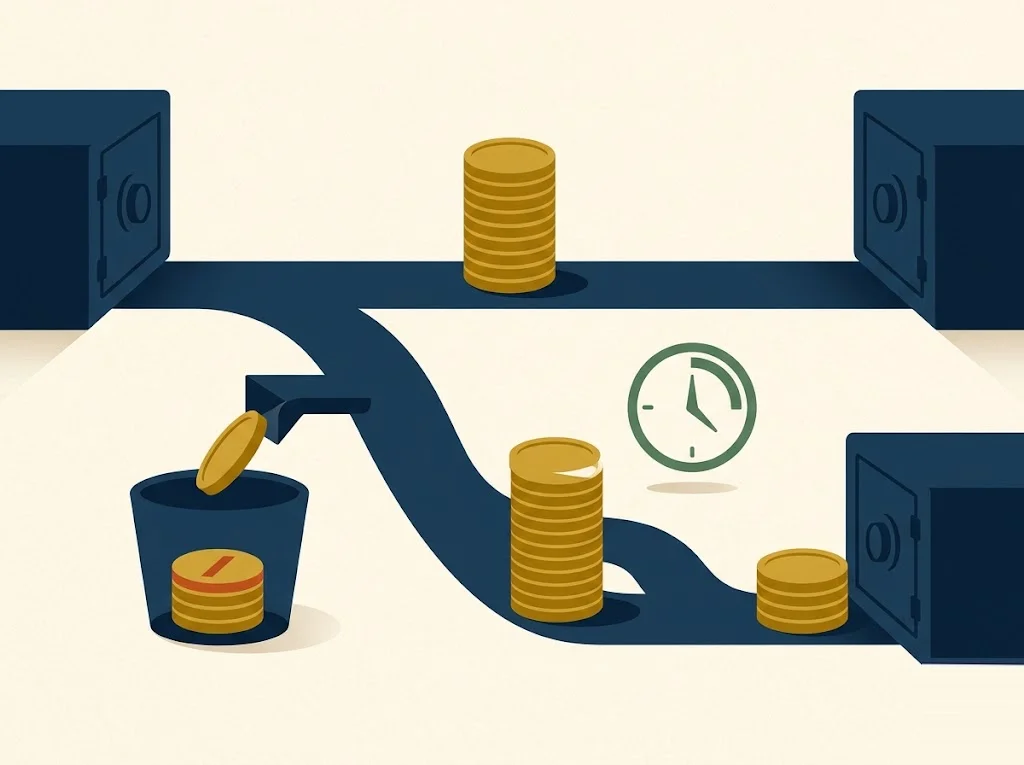
The day you leave a job, your 401(k) does not leave with you automatically — it sits in your former employer’s plan, waiting for an instruction. You have four ways to give it one: leave the money where it is, roll it into your new employer’s plan, roll it into an individual retirement account, or cash it out. That last option is the one to retire from consideration first, because cashing out triggers ordinary income tax, a 10% early-withdrawal penalty if you are under 59½, and the permanent loss of decades of compounding on money that was supposed to be untouchable until retirement.
Assuming you choose to roll the money rather than spend it, a second fork appears — quieter, more technical, and far more expensive if you take it blind. There are two mechanical ways to move a 401(k), and they look almost identical on a form. One moves your money directly from the old plan to the new account. The other pays the money to you and trusts you to redeposit it within 60 days, after the IRS has already taken a 20% bite it will not return until you file. The first route is boring and safe. The second has a trap built into it that catches people every tax season.
A direct rollover — trustee-to-trustee — moves your full 401(k) balance straight to the receiving account with no tax withheld and nothing reported as income; it is the default, safe route. An indirect rollover pays you personally, and federal law (IRC §3405) forces the plan to withhold 20% of a pre-tax distribution. You then have 60 days to redeposit the money. On a $100,000 indirect rollover the plan hands you $80,000 and sends $20,000 to the IRS, but to complete a fully tax-free rollover you must deposit the entire $100,000 — fronting the missing $20,000 from your own pocket and recovering it as a refund. Redeposit only the $80,000 and that $20,000 is taxed as income, plus a 10% penalty under age 59½. Miss the 60 days entirely and the whole $100,000 is taxable.
How a direct rollover works
A direct rollover, also called a trustee-to-trustee transfer, is the route the IRS, your old plan, and your new custodian all quietly prefer. You open the receiving account first — a traditional IRA, a Roth IRA, or your new employer’s 401(k) — and then instruct the old plan to send the money there directly. In practice this often arrives as a check, but a particular kind of check: one made payable not to you but to the new custodian “for the benefit of” you. You may physically handle that check while forwarding it, yet because it cannot be cashed by you personally, the IRS does not treat it as a distribution to you.
The consequences of that distinction are entirely favorable. No tax is withheld. Nothing lands on your tax return as income. There is no deadline pressure, because the money is never in legal limbo. And critically, the “one rollover per 12 months” rule — the one that limits how often you can shuffle retirement money around — does not apply to direct transfers at all. That limit governs only IRA-to-IRA indirect rollovers; trustee-to-trustee transfers and 401(k)-to-IRA rollovers are effectively unlimited. If you have several old plans to consolidate, you can direct-transfer all of them in the same week without consequence. This is the route to choose unless you have an unusual and deliberate reason not to.
How an indirect rollover works — and where the 20% lurks
An indirect rollover, sometimes called a 60-day rollover, inverts the flow: the plan pays you. The check comes in your name, the money is yours to deposit wherever you like, and you have 60 days from receipt to land it in an IRA or eligible plan. That flexibility is the whole appeal, and it is also the whole problem, because the moment a pre-tax 401(k) pays you directly, Internal Revenue Code §3405 compels the plan to withhold 20% for federal taxes. This is mandatory. The plan cannot waive it even when you tell them, in writing, that you intend to roll every dollar over within the week.
So the arithmetic quietly bends against you. The plan reports a full distribution, withholds a fifth of it, and sends you the remaining four-fifths. To roll over the full amount — which is the only way to keep the whole thing tax-free — you must somehow deposit the original figure, including the 20% you never received. You make up that gap from your own savings, then recover the withheld amount as a credit or refund when you file your return. Whatever you fail to redeposit is treated as a taxable distribution: ordinary income, plus the 10% early-withdrawal penalty if you are under 59½. The withholding is not a fee; it is a prepayment you have to chase.
A worked example: $100,000, three outcomes
Picture a $100,000 traditional 401(k) balance and three ways it can play out. A direct rollover is uneventful: nothing is withheld, the full $100,000 lands in the IRA, and no tax is due. An indirect rollover done correctly is more work but lands in the same place — provided you front the cash. An indirect rollover done carelessly is where the money leaks.
| Scenario | Withheld | You receive | You must deposit | Tax result |
|---|---|---|---|---|
| Direct (trustee-to-trustee) | $0 | — (paid to custodian) | $100,000 lands automatically | $0 tax |
| Indirect done right | $20,000 | $80,000 | $100,000 within 60 days (front the $20,000) | $0 tax; $20,000 refunded at filing |
| Indirect done wrong | $20,000 | $80,000 | only $80,000 redeposited | $20,000 taxed + (under 59½) $2,000 penalty |
The middle row is the one that surprises people. To complete a fully tax-free $100,000 rollover, you must deposit $100,000 even though the plan only handed you $80,000 — the missing $20,000 comes out of your own savings, and you get it back as a credit or refund when you file. The bottom row is the default outcome for anyone who deposits only what they received: that orphaned $20,000 becomes taxable income, and under 59½ the 10% penalty adds another $2,000. And if you miss the 60-day window altogether, none of this matters — the entire $100,000 is taxed as ordinary income, with the penalty on top.
The caveats that actually bite
The first caveat is tax character, and it is easy to get right and expensive to get wrong. A traditional, pre-tax 401(k) rolls into a traditional IRA with no tax. A Roth 401(k) rolls into a Roth IRA with no tax. But rolling pre-tax 401(k) money into a Roth IRA is not a rollover at all — it is a conversion, and the entire amount is added to your taxable income for the year. That can be a deliberate, smart move as one rung of a Roth conversion ladder, but it should never happen by accident on a form. If you are unsure which account type you have, the distinction between a Roth and a traditional IRA is worth settling before you initiate anything.
The second caveat is subtler and trips up high earners specifically. Rolling a pre-tax 401(k) into a traditional IRA is clean and tax-free in the moment — but those pre-tax dollars now sit in your IRA, where they sabotage a future backdoor Roth. The reason is the pro-rata rule: the IRS does not let you cherry-pick after-tax dollars to convert, so every backdoor conversion is taxed proportionally across all your pre-tax IRA money. A balance that was tax-free to roll can quietly make years of backdoor conversions taxable. The defense is to roll the old 401(k) into your new employer’s plan instead, which keeps your IRA empty of pre-tax money and leaves the backdoor — and the mega backdoor Roth, if your plan supports it — fully open.
The third caveat is the one-rollover-per-12-months rule, which earns repeating because it is so narrow that people over-fear it. It applies only to IRA-to-IRA indirect rollovers. It does not touch direct trustee-to-trustee transfers, and it does not touch 401(k)-to-IRA rollovers. If your moves are direct, the limit is irrelevant to you.
Who should use which method
For almost everyone, the answer is the direct rollover, every time. It carries no withholding, no deadline, no 12-month limit, and no way to accidentally trigger a tax bill — it is strictly safer than the indirect route with no offsetting advantage for the typical mover. The only honest reason to choose an indirect rollover is if you genuinely need to use the funds for fewer than 60 days as a short-term bridge, can replace the withheld 20% from other savings, and accept the risk that a missed deadline taxes the entire balance. That is a narrow and nervous use case, and it is closer to a 401(k) loan than a withdrawal in spirit — a way to touch the money briefly, with real consequences if the plan slips.
The deeper decision is not how to move the money but where. Roll into an IRA for the widest investment menu and the simplest single account; roll into your new employer’s plan to keep your IRA pristine for backdoor conversions, to retain access to plan loans, or to consolidate under one roof. Both keep your retirement savings inside the tax-advantaged system, which is the entire point — and that system, the order in which you fill each account, is worth understanding as a deliberate hierarchy rather than a series of accidents. Whatever you decide, pick the direct route to get there. The 20% trap only catches people who hand the money to themselves first.
Sources
- IRS — Rollovers of retirement plan and IRA distributions — direct versus indirect (60-day) rollovers, the 20% mandatory withholding on indirect rollovers, and the one-rollover-per-12-months rule for IRA-to-IRA transfers.
- IRS — Topic No. 413, Rollovers from Retirement Plans — the 60-day window, tax treatment of amounts not rolled over, and the 10% additional tax under age 59½; references the mandatory withholding under IRC §3405.
- IRS — Rollover Chart — which account types may roll into which, including traditional-to-traditional and Roth-to-Roth, and the taxable conversion of pre-tax money into a Roth IRA.
This is general educational information, not tax advice. Rollover rules carry strict deadlines and account-specific consequences; confirm your situation with a CPA or tax professional before moving retirement money.
Quick answers
What is the difference between a direct and indirect 401(k) rollover?
In a direct rollover — trustee-to-trustee — the old plan sends your money straight to the receiving account, often as a check made payable to the new custodian for your benefit, which you simply forward. No tax is withheld and nothing is reported as income. In an indirect rollover the plan pays you personally, and by law it must withhold 20% of a pre-tax distribution for federal taxes. You then have 60 days to redeposit the money into an IRA or plan. The direct route is the default, safe one; the indirect route hands you a deadline and a withholding gap to close.
Why does my 401(k) withhold 20% on an indirect rollover?
Federal law requires it. Under Internal Revenue Code §3405, any pre-tax 401(k) distribution paid directly to you carries a mandatory 20% federal withholding — the plan has no discretion to waive it, even if you intend to roll the money over. So a $100,000 distribution arrives as an $80,000 check, with $20,000 sent to the IRS. You recover that $20,000 as a credit when you file your tax return, but only if you completed the rollover. A direct trustee-to-trustee transfer avoids the withholding entirely because the money never passes through your hands.
What happens if I miss the 60-day rollover deadline?
The clock is unforgiving. If you do not redeposit the funds into an IRA or eligible plan within 60 days of receiving them, the entire distribution becomes taxable as ordinary income. On a $100,000 indirect rollover, missing the window entirely means the full $100,000 is taxed — and if you are under age 59½, a 10% early-withdrawal penalty stacks on top. Even a partial miss is costly: if you only redeposit the $80,000 you received and never replace the withheld $20,000, that $20,000 alone is taxed plus penalized.
Should I roll my 401(k) into an IRA or my new employer's plan?
It depends on whether you ever plan to use the backdoor Roth strategy. Rolling a pre-tax 401(k) into a traditional IRA is clean and tax-free, but it fills your IRA with pre-tax dollars that then enter the pro-rata calculation and tax any future backdoor Roth conversion. If that is a concern, rolling into your new employer's 401(k) instead keeps your IRA empty of pre-tax money and preserves the backdoor. For most people without that complication, an IRA offers more investment choice and is the simpler home.
Educational content only. finbarrow is an independent editorial publication, not a licensed financial advisor, broker, tax preparer, or attorney. Verify rates and terms with the issuer or relevant regulator. See disclaimers and funding disclosures.