Foreign transaction fees + DCC — how 3% becomes 5% abroad
The double-cost mechanic when paying abroad: foreign transaction fees, dynamic currency conversion markups, and the no-fee cards that avoid both.
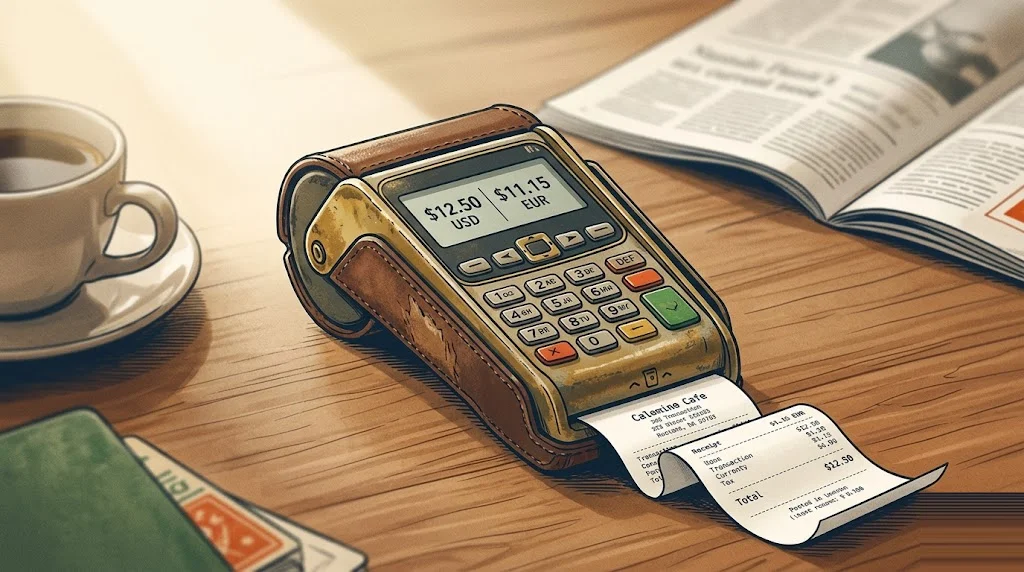
Spending abroad on a US credit card looks identical on the terminal to spending at home, but the underlying mechanics can add 3-10% of cost beyond what the local price says. The two cost vectors — foreign transaction fees from your card issuer, and dynamic currency conversion offered by the merchant — can stack on the same transaction. For a US traveler spending $5,000 on a trip with the wrong card and accepting DCC at every terminal, the avoidable extra cost is $300-$500. With the right card and a single rule for the terminal prompt, the extra cost is zero.
This guide walks through what each cost is mechanically, why the “pay in USD?” prompt at a foreign terminal is structurally a trap, the cards that avoid foreign transaction fees entirely, and the operational protocol for spending abroad without leaking 3-5% to invisible markups.
What “foreign transaction fee” actually is
A foreign transaction fee (FTF) is a charge from your credit card issuer that applies to any transaction processed outside the United States. Two conditions can trigger the FTF:
- Currency conversion — the transaction is in a currency other than USD (most international purchases).
- Foreign processing — the merchant’s payment processor is foreign-located, even if the charge is denominated in USD. A few US-themed merchants in tourist areas of foreign countries route through US processors and avoid this trigger; the vast majority do not.
The FTF is typically 1-3% of the transaction amount, applied at the issuer level. It is a separate charge from the underlying currency conversion (which is performed at the Visa/Mastercard/Amex network’s wholesale rate with zero spread before being forwarded to the issuer). The FTF is the issuer’s piece — historically presented as covering “the cost of international transaction processing” though the actual cost to the issuer is fractional compared to the fee charged.
Premium travel-positioned credit cards typically charge 0% FTF as a deliberate marketing feature to compete for the international traveler segment. No-annual-fee cards often charge 2-3% as the default. The issuer’s terms-and-conditions page or cardholder agreement spells out the exact FTF for any specific card.
What dynamic currency conversion is
Dynamic currency conversion (DCC) is a separate cost vector controlled by the merchant or the payment terminal, not by your card issuer. When you tap or insert your US card at a foreign terminal, the terminal recognizes you as a foreign cardholder (based on the BIN — bank identification number — of your card) and offers to “do the conversion for you” so you can see and approve a USD amount on the receipt instead of a local-currency amount.
The terminal asks something like: “Would you like to pay in USD or [local currency]? USD: $108.50. EUR: €100.00.” Both are technically the same purchase, just denominated differently. The catch: the USD amount is computed using the terminal’s exchange rate, which the merchant or terminal vendor (DCC providers like Planet Payment, Continuum Commerce, and similar) sets with a 3-7% markup over the actual wholesale market rate. The markup is the merchant’s revenue from the DCC service; the network and issuer get the same processing fee regardless of which currency choice you make.
The FTF from your card issuer applies AFTER the DCC markup. So accepting DCC with a 2% FTF card means you pay:
- DCC markup (~5% built into the USD price the terminal shows) PLUS
- FTF (2% on the converted USD amount)
Versus paying in local currency:
- Network wholesale FX rate (no spread) PLUS
- FTF (2% on the converted USD amount, but applied to a wholesale-rate conversion)
The wholesale path is ~5% cheaper on the same purchase, with no operational difference to the traveler beyond saying “local currency” at the terminal prompt.
The math on a $5,000 trip
Three scenarios on a $5,000 European trip:
Scenario 1: typical no-annual-fee card (2.5% FTF) + accept DCC at every terminal
- Underlying purchases: $5,000 USD-equivalent at local prices
- DCC markup (avg 5%): adds $250 to the USD-denominated total
- USD-denominated charges: $5,250
- FTF (2.5% of $5,250): $131
- Total cost: $5,381 — $381 of avoidable extra cost (7.6% leakage)
Scenario 2: typical no-annual-fee card (2.5% FTF) + always pay in local currency
- Underlying purchases: €4,630 at €→$ wholesale rate of ~1.08 = $5,000
- DCC markup: $0 (declined at terminal)
- FTF (2.5% of $5,000): $125
- Total cost: $5,125 — $125 of FTF cost (2.5% leakage)
Scenario 3: no-FTF travel card (e.g., Sapphire Preferred, Venture, Amex Platinum) + always pay in local currency
- Underlying purchases: €4,630 at wholesale rate = $5,000
- DCC markup: $0
- FTF: $0
- Total cost: $5,000 — zero leakage
The cumulative leakage savings of upgrading from Scenario 1 to Scenario 3 is $381 on a single trip. For a household traveling internationally annually with significant card spend abroad, the no-FTF card pays for itself even at $95-$895 annual fees within 1-3 trips for substantive travelers.
Which US cards charge zero foreign transaction fee
The list shifts as issuers adjust card features. As of early 2026, the following major US credit cards have 0% FTF (always verify in the current cardholder agreement before traveling):
No-annual-fee cards with 0% FTF (the high-value finds):
- Capital One Quicksilver Cash Rewards (and Quicksilver One sub-prime variant)
- Capital One SavorOne Cash Rewards
- Capital One VentureOne Rewards
- Every Discover card (Discover it Cash Back, Discover it Miles — Discover charges no FTF on any card)
- Bank of America Travel Rewards
Annual-fee travel cards with 0% FTF (the standard premium):
- Chase Sapphire Preferred ($95)
- Chase Sapphire Reserve ($795)
- Chase Ink Business Preferred
- Amex Platinum Card ($895)
- Amex Gold Card ($325)
- Amex Green Card
- Capital One Venture Rewards ($95)
- Capital One Venture X Rewards ($395)
- Citi Premier ($95)
- US Bank Altitude Reserve ($400)
- Bank of America Premium Rewards Elite ($550)
Common cards that DO charge FTF (avoid for international spend):
- Chase Freedom Unlimited (3% FTF)
- Chase Freedom Flex
- Citi Double Cash (3% FTF)
- Most retail co-brand cards (Target, Best Buy, Amazon Prime Rewards, etc.)
- Most no-annual-fee cards from regional banks
Note: Discover charges no foreign transaction fee on any of its cards — every Discover card (including Discover it Cash Back and Discover it Miles) is a 0% FTF card you may use worldwide where Discover is accepted. It belongs in the no-FTF column, not here.
For a traveler who carries multiple cards, the no-FTF card should be the default for any international transaction; the high-rewards-category card for domestic spend.
Debit card considerations
Debit cards have their own FTF policy independent of credit cards from the same bank. Most US bank-issued debit cards charge:
- 1-3% FTF on foreign currency transactions (Bank of America, Wells Fargo, Chase, Citi, US Bank typical)
- A per-transaction fee of $2-5 for foreign ATM withdrawals
- The ATM operator’s fee on top ($3-10 per withdrawal at foreign ATMs)
For a $200-equivalent ATM withdrawal in Europe with a typical US big-bank debit card, the total cost can be:
- $200 base withdrawal
- Visa wholesale FX rate
- 3% FTF = $6
- $5 per-transaction fee
- $5 ATM operator fee
- Total: $216 for $200 of cash — 8% leakage
Two debit card exceptions with no foreign ATM fees:
- Schwab Bank Investor Checking debit card — reimburses all ATM fees globally, including foreign ATMs. The wholesale FX rate applies with no FTF.
- Fidelity Cash Management Account debit card — similar policy, all ATM fees reimbursed.
For households who travel internationally regularly and need foreign cash, opening a Schwab Bank checking account (free, no minimum) specifically for the debit card is a $100-$500/year saver. The account does not need to be your primary checking — many travelers fund it $500 ad hoc before each trip.
Operational protocol for spending abroad
Pre-trip (one-time setup):
- Audit your current card lineup. Identify which cards have 0% FTF; mark them as the international defaults.
- If no card with 0% FTF, consider applying for one before the trip (Capital One Quicksilver is the most accessible no-annual-fee option; Capital One Venture X or Sapphire Preferred for higher-spend travelers).
- For foreign cash, open a Schwab Bank or Fidelity CMA account if not already.
- Notify your card issuers of travel dates via the issuer app or web portal — most major issuers no longer require this since fraud detection has matured, but a notification still prevents the occasional false-positive lockout.
At every foreign terminal:
- When the terminal asks “USD or [local currency]?”, always choose local currency. No exceptions.
- If you tap or insert and the terminal silently runs DCC without prompting, ask the merchant to reverse and re-run in local currency. Most merchants will if asked immediately.
- For online purchases on foreign sites, check whether the merchant’s checkout shows USD or local currency. If USD, the same DCC issue may apply — try changing the currency display to local before checkout.
At foreign ATMs:
- Use a Schwab or Fidelity CMA debit card if you have one — fees auto-reimbursed.
- Choose “local currency” if prompted (some ATMs offer DCC).
- Withdraw larger amounts less frequently to amortize any per-transaction fees over more cash.
- Avoid currency exchange counters at airports and hotels (typically 8-15% spread — far worse than any ATM withdrawal).
What this guide does not cover
This guide focused on US-issued credit and debit cards used at foreign physical terminals or online. It does not cover:
- Wire transfer mechanics for moving substantial cash abroad — different cost structure (Wise, Revolut, traditional bank wires).
- Multi-currency accounts like Wise/Revolut/Mercury — useful for international workers and frequent travelers but introduces account-management complexity.
- Cryptocurrency-based international payments — increasingly common but has its own tax and security considerations.
- Country-specific exceptions — a few destinations have unusual payment landscapes (Cuba sanctions, China’s cashless system, etc.) requiring separate analysis.
- Currency hedging for business expenses — relevant for self-employed travelers receiving foreign-denominated payments.
For mainline US-tourist credit card use abroad, the protocol above is complete.
What to verify before traveling
Always check the current FTF on the specific cards you plan to use:
- Cardholder agreement for each card — the FTF section is typically on page 2-3 of the agreement, look for “Foreign transaction” or “International” in the fee schedule.
- Issuer travel pages: chase.com/credit-cards/travel, americanexpress.com/travel, capitalone.com/credit-cards/travel
- Schwab Bank Visa Platinum Debit Card terms: schwab.com/checking-fees (verify ATM rebate policy)
- Fidelity Cash Management Account debit policies: fidelity.com/cash-management/overview
FTF terms are stable but occasionally change at the issuer’s discretion (with 45-day notice required under federal law). Re-verify before each major international trip if it has been more than a year since the last check.
Quick answers
What is the difference between a foreign transaction fee and dynamic currency conversion?
They are two separate costs that can stack on the same purchase abroad. A foreign transaction fee (FTF) is charged by your card issuer for any transaction processed outside the US, typically 1-3% of the transaction. Dynamic currency conversion (DCC) is offered at the point of sale by the merchant or terminal — they ask if you want to pay in your home currency (USD) instead of local currency, then they apply their own exchange rate that is typically 3-7% worse than the actual market rate. The merchant takes that markup. If you accept DCC AND your card charges a foreign transaction fee, you pay both — DCC markup PLUS FTF. The correct answer at the prompt is always "local currency" (let your card's network — Visa/Mastercard/Amex — do the conversion at the wholesale rate, then your card's FTF policy determines whether you pay the 1-3% fee on top of that).
Do all US credit cards charge foreign transaction fees?
No. Most premium travel cards (Chase Sapphire Preferred, Sapphire Reserve, Amex Platinum, Amex Gold, Capital One Venture, Capital One Venture X, Bank of America Premium Rewards Elite, US Bank Altitude Reserve, and dozens of others) charge zero foreign transaction fee as a deliberate marketing feature. Most no-annual-fee credit cards from major issuers do charge 1-3% FTF — Chase Freedom Unlimited, Citi Double Cash, and similar. A handful of no-annual-fee cards do not charge FTF (Capital One Quicksilver, Capital One SavorOne, and every Discover card — Discover charges no foreign transaction fee on any of its cards, including Discover it Cash Back and Discover it Miles). Always verify in the cardholder agreement before traveling; the FTF is one of the fastest-to-confirm details on a card issuer page.
What happens if I use my US debit card abroad?
Debit cards have their own FTF policy separate from credit cards. Most US bank-issued debit cards charge a foreign transaction fee of 1-3%, often plus a fixed per-transaction fee of $2-5 on top. Plus the ATM operator (the foreign bank running the ATM) typically charges another $3-10 per withdrawal regardless of your bank. The combined cost of a foreign ATM withdrawal from a typical US bank debit card can easily be 5-10% of small withdrawals. Schwab Bank checking and Fidelity Cash Management debit cards refund all ATM fees globally including foreign ATM fees, making them substantially cheaper for international cash needs than a typical big-bank debit card. Verify ATM fee refund policy at the bank's rate disclosure page — terms have shifted historically.
Is paying in local currency always cheaper than paying in USD via DCC?
Yes, with no realistic exception for a typical US traveler. The merchant or terminal offering DCC sets the exchange rate they use, and they have no incentive to offer a rate close to the market — the spread is their margin. Visa, Mastercard, and Amex all publish their daily wholesale FX rates and apply them with no markup before forwarding to the issuer. The issuer's FTF (if any) is the only markup on top of the wholesale rate. Wholesale rate + 0% FTF (premium card) is always cheaper than DCC rate + 0% FTF. Wholesale rate + 3% FTF is also typically cheaper than DCC rate (which often includes 5-7% built-in markup PLUS the FTF still applies). The math just does not favor DCC. If you accidentally accept DCC at a terminal, most merchants will reverse and re-run the transaction in local currency if you ask immediately.
Educational content only. finbarrow is an independent editorial publication, not a licensed financial advisor, broker, tax preparer, or attorney. Verify rates and terms with the issuer or relevant regulator. See disclaimers and funding disclosures.