The 0% capital gains bracket — the planning lever most filers miss
For single filers under ~$49K and couples under ~$99K of taxable income, long-term capital gains are taxed at 0% federal. The structural mechanics.
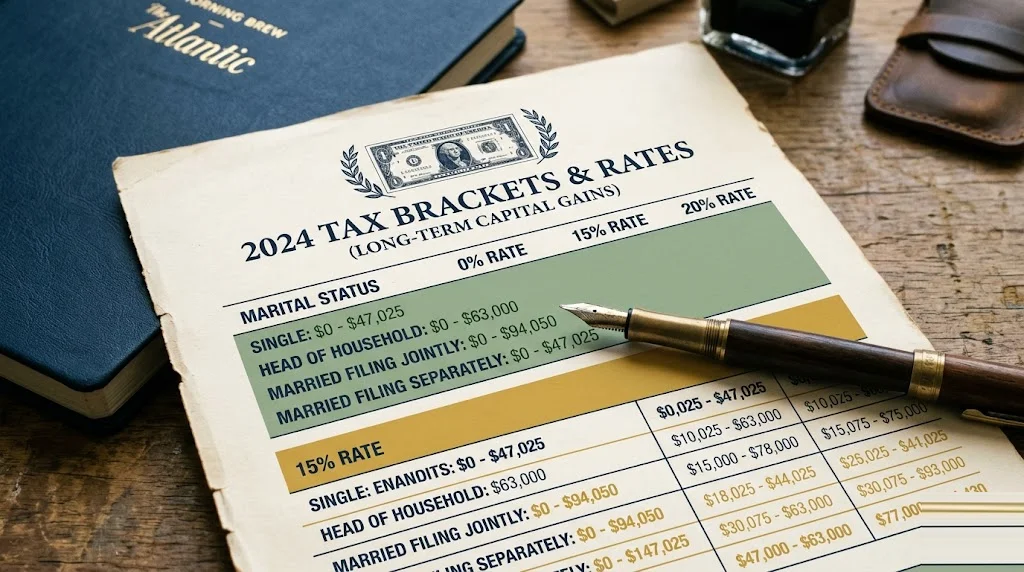
The US federal tax code includes a 0% bracket for long-term capital gains that is one of the most underused tax-planning levers available to US households. For single filers with taxable income below approximately $49,450 in 2026, and married couples filing jointly below approximately $98,900, long-term capital gains owe zero federal income tax. The exact thresholds shift each year with inflation adjustments published by the IRS; the structural existence of the 0% bracket has been stable since the Bush-era 2003 capital gains reforms made permanent in 2012, and survived multiple subsequent tax-code revisions.
The lever is real, the math is mechanical, and yet the vast majority of US filers who could legitimately use it never do. This piece walks through what the 0% bracket is, who qualifies, the “gain harvesting” strategy that converts the bracket into a portfolio-level basis step-up, and the cases where filers leave thousands of dollars of free basis on the table by not running the calculation.
The structural rule
US long-term capital gains (gains on assets held more than one year and sold in a taxable brokerage account) are taxed at one of three preferential rates depending on the filer’s taxable income:
- 0% for taxable income up to the published threshold (approximately $49,450 single, $98,900 MFJ for 2026; verify current year at irs.gov/taxtopics/tc409).
- 15% for taxable income between the 0% threshold and approximately $545,500 single ($613,700 MFJ).
- 20% for taxable income above the 15% threshold.
These rates apply to taxable income — which is AGI minus the standard deduction (or itemized) — not gross income. A household with $80,000 AGI taking the $32,200 standard deduction (MFJ) lands at $47,800 of taxable income, well within the 0% LTCG bracket. The taxable-income-not-AGI distinction matters: many households assume they exceed the 0% bracket based on their gross or AGI numbers when in fact their taxable income (post-deduction) lands them squarely in 0% territory.
The 0% bracket is filled by ordinary income FIRST (wages, interest, business income, etc.), then capital gains slot on top. If your ordinary taxable income is $30,000 (well under the 0% LTCG ceiling), you have ~$19,000 of headroom in the 0% bracket that can absorb $19,000 of long-term capital gains tax-free. If your ordinary taxable income is $55,000 (over the 0% LTCG ceiling for single), zero capital gains qualify for 0% — they all get taxed at 15%.
Who actually qualifies
The 0% bracket applies to far more households than commonly assumed. Specific scenarios where it routinely applies:
- Early retirees in the gap between leaving the workforce and starting Social Security or 401(k) RMDs. With taxable income drawn primarily from a taxable brokerage at $40,000-$60,000/year, a couple’s taxable income often lands comfortably under the MFJ 0% ceiling.
- Households with one earner and one stay-at-home parent where combined wages are $80,000-$95,000 — after the MFJ standard deduction, taxable income lands $50,000-$66,000, within the 0% bracket.
- Filers with significant pre-tax 401(k) contributions — a household earning $110,000 with both spouses maxing 401(k) ($24,500 each = $49,000) is at $61,000 AGI, roughly $28,800 taxable income MFJ. Full 0% LTCG bracket available.
- Gig workers / freelancers in startup years with low net Schedule C income while building a business.
- Recent graduates in their first year of professional work with partial-year wages.
For all of these households, $5,000-$30,000 of long-term capital gains realized in the qualifying year are entirely federal-tax-free. The IRS does not need to be told to apply the 0% rate; the Schedule D / Form 1040 calculation does it automatically based on the qualifying taxable income. The discovery happens only if the filer realizes the gain by selling and rebuying.
Gain harvesting — the under-the-radar strategy
The companion strategy to tax-loss harvesting (selling losers to capture a deduction) is “gain harvesting” — deliberately selling winners in 0%-bracket years to step up the cost basis. Unlike loss harvesting, gain harvesting does NOT trigger the wash sale rule (the wash sale rule applies only to losses, not gains), so the seller can immediately rebuy the same security at the new higher basis without waiting 31 days.
The mechanical play:
- Identify a long-term holding in your taxable brokerage with significant unrealized gain (e.g., VTI bought 10 years ago at $100/share, now $250).
- Project your taxable income for the year. If projected taxable income leaves room in the 0% LTCG bracket, identify how much gain you can harvest without crossing into 15%.
- Sell the calculated amount of shares at current market price. The realized gain is the difference between current price and original basis.
- Immediately buy back the same shares (no wash sale issue for gains). The new lot’s cost basis is the current price — a “step up” from the original basis.
- The harvested gain shows on Schedule D, lands in the 0% bracket, and the new lot’s reset basis means less taxable gain when eventually sold years later.
For a household with $20,000 of room in the 0% bracket and a position with $20,000 of unrealized gain, the harvest creates $20,000 of basis step-up at zero federal tax cost. If the household eventually sells that lot in a 22%-bracket year decades later, they save $20,000 × 15% = $3,000 of future tax — for taking a 30-minute action today.
Worked example: FIRE retiree at $55,000 AGI
A couple in early retirement: $55,000 AGI sourced from a taxable brokerage account dividends and interest. Standard deduction MFJ 2026: ~$32,200. Taxable income: $22,800.
2026 MFJ 0% LTCG bracket ceiling: ~$98,900. Their ordinary income occupies $22,800 of that. Available 0% room for capital gains: $98,900 - $22,800 = $76,100 of headroom.
They identify their VTI taxable position bought in 2014 at $90/share, now worth $250/share. $160 unrealized gain per share. To harvest $70,000 of gain, they sell ~437 shares at $250 = $109,250 proceeds, realizing $69,920 of long-term gain.
Federal tax on the harvest: $0 (the entire $69,920 fits in the 0% bracket since taxable income remains under the $98,900 MFJ ceiling).
State tax: depends on residence. Texas/Florida/Nevada: $0 state. California: $69,920 × 9.3% = $6,503 state tax owed (CA taxes LTCG as ordinary income).
The next day, they buy back $109,250 of VTI at $250/share = ~437 shares. Same portfolio exposure. New cost basis: $250/share. When they eventually sell that lot in a higher-bracket year, the future taxable gain is calculated from $250, not $90 — a $70,000 step-up that saves potentially $10,500-$14,000 of future federal tax depending on the future bracket.
For a no-state-tax household, the harvest costs $0 today and saves $10,500+ in future federal tax. For a California household, the harvest costs $6,503 today (state) and still saves $10,500+ federal — net positive but more nuanced.
The constraints
The 0% bracket is calendar-year-specific. A household that has the 0% room available in 2026 may not have it in 2027 if they return to work, take a large distribution, or convert Roth balances. The window may be 1-2 years, not permanent. Run the projection annually.
ACA Premium Tax Credit interaction. Households on ACA marketplace health insurance calculate Premium Tax Credits based on MAGI. Realized capital gains count toward MAGI even when they fall into the 0% federal bracket. A large gain harvest can push MAGI over the PTC cliff, costing thousands in repaid subsidies. The optimization: harvest only enough gain to keep MAGI under the PTC threshold.
State tax differential. The federal 0% bracket has no state-tax parallel in most states that tax capital gains. California taxes LTCG as ordinary income up to 12.3%. Washington introduced a 7% state capital gains tax above a threshold. Households should run state-tax math alongside federal — sometimes the state cost negates the federal benefit, especially for very low-state-tax-bracket residents who might otherwise pay 0% state too if income were lower.
Social Security benefit taxation. For ages 62+, realized capital gains count as “provisional income” for the Social Security benefit taxation formula, which can push more SS benefits into the taxable portion (up to 85%). FIRE retirees before claiming SS are not yet affected; older retirees should run the SS interaction carefully.
Net Investment Income Tax (NIIT). The 3.8% NIIT applies to long-term capital gains for filers above $200,000 MAGI single, $250,000 MAGI MFJ. Filers near these thresholds should account for the 3.8% surcharge in their harvest planning even if the underlying gain is in the 0% bracket.
Where to verify
Always pull current-year specifics:
- Capital gains brackets for the tax year: irs.gov/taxtopics/tc409
- Standard deduction current year: irs.gov/forms-pubs/about-publication-501
- Annual inflation adjustments: irs.gov/newsroom (search “Tax Year XXXX Inflation Adjustments”)
The structural rule does not change year to year. What changes: the dollar thresholds (indexed for inflation), the NIIT threshold (statutory, has not been adjusted since enactment), and state-level treatment. Run the math at the time of the harvest, not based on prior-year assumptions.
The 0% bracket is one of the highest-ROI tax-planning levers available to qualifying US households. Most years, most qualifying filers leave the benefit on the table by not running the calculation. For households in the bracket — early retirees, single-earner families, gig workers in startup years — the 30-minute action of running the projection and executing a calibrated harvest can produce $5,000-$15,000 of permanent tax savings on a single harvest.
Sources
- IRS — Topic No. 409 Capital Gains and Losses (current-year brackets) (accessed May 19, 2026)
- IRS Publication 550 — Investment Income and Expenses (accessed May 19, 2026)
- IRS — Tax Year 2026 Inflation Adjustments (Revenue Procedure) (accessed May 19, 2026)
Related on finbarrow
- Investing & Retirement
Roth IRA, 401(k), index funds — decisions you make once a decade.
- Taxes
Filing, withholding, quarterly estimates — Form 1040 line by line.
Educational content only. finbarrow is an independent editorial publication, not a licensed financial advisor, broker, tax preparer, or attorney. Verify rates and terms with the issuer or relevant regulator. See disclaimers and funding disclosures.